Month: April 2025

  • Catching the Rain: Transforming Forest Health Surveillance with Environmental DNA (eDNA)

    Catching the Rain: Transforming Forest Health Surveillance with Environmental DNA (eDNA)

    Forests play a pivotal role in carbon sequestration, biodiversity conservation, and the provision of economic resources. However, plant pests and pathogens pose significant threats, resulting in billions of dollars in annual losses and reducing the effectiveness of forests in mitigating climate change. Traditional forest health surveillance, which relies largely on visual inspection, often detects disease only after substantial spread has occurred. This delay in detection highlights the urgent need for innovative technologies that enable sustainable and proactive forest protection. A recent study illustrates how environmental DNA (eDNA) offers groundbreaking possibilities for early pathogen detection, saving time and costs while improving eradication outcomes.

    Understanding Environmental DNA (eDNA)

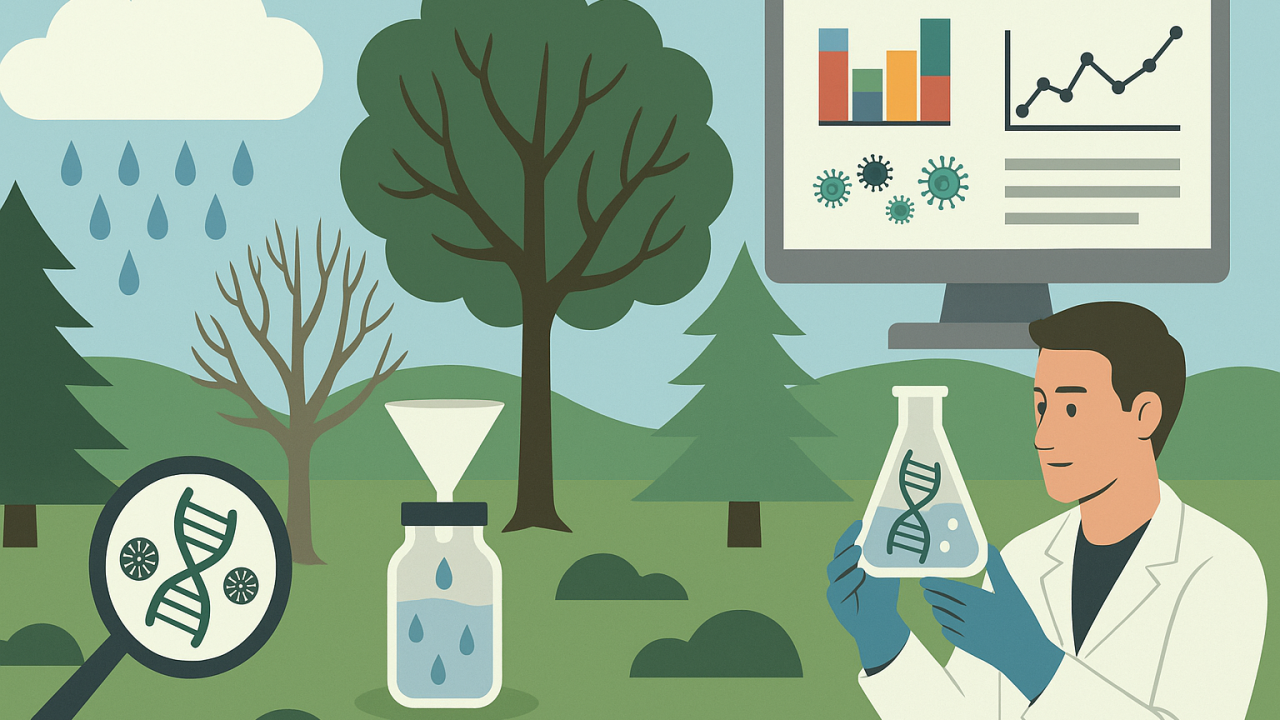
    Environmental DNA refers to genetic material shed by organisms into their surroundings, detectable in rainwater, soil, or air samples. It provides a snapshot of biological diversity, allowing for the detection of organisms before visible signs of their presence emerge. In this study, rainwater samples collected from forest sites in Northern Ireland were analysed to detect fungal and oomycete pests, demonstrating the viability of eDNA for forest health monitoring.

    Rainwater Sampling Across Northern Ireland’s Forests

    The study gathered data from five forest sites: Lough Navar, Davagh, Loughgall, Hillsborough, and Mount Stewart. These sites were selected to represent a range of forest types, from dense spruce and pine monocultures to mixed recreational areas containing oak, ash, and beech. Environmental conditions, including rainfall and temperature, were also recorded to contextualise the findings.

    Rainwater traps were strategically placed beneath different tree species—oak, pine, spruce, and ash—as well as in open fields. Over 12 months, scientists collected 480 rainwater samples. Filtering and DNA extraction were performed using advanced techniques to maximise recovery and preservation of genetic material.

    From DNA to Detection: Advanced Analytical Techniques

    The captured eDNA was analysed using metabarcoding, a next-generation sequencing (NGS) approach targeting specific genetic markers, such as the ITS1 region. This technique enabled the identification of fungal and oomycete pests with high precision. Unlike traditional PCR, which requires prior knowledge of the target organism, NGS offers the capacity to detect both known and previously unrecorded pests—transforming early detection capabilities.

    Raw DNA sequences were processed through custom-built bioinformatics pipelines on high-performance computing systems. Tools such as QIIME2 and ANCOM-BC were employed to classify sequences, normalise data, and reveal significant patterns in pest diversity and abundance across different trees, sites, and seasons.

    Key Findings

    Analysis of the data revealed the presence of 65 fungal and oomycete pests within the rainwater samples, nine of which appear on the UK Plant Health Risk Register. Notably, two pests—Gnomoniopsis idaeicola and Sirococcus piceicola—were detected for the first time in Northern Ireland.

    The highest number of pest detections occurred in November, with autumn emerging as the most active season for fungal and oomycete pests. However, pest diversity peaked during both summer and autumn, reflecting the life cycles of many fungi, which tend to fruit and sporulate during these periods.

    Some pests exhibited clear preferences for particular tree species or sites. For example, Monochaetia monochaeta was found exclusively beneath oak trees, while pine tree traps captured pathogens associated with needle diseases. Interestingly, field traps—positioned away from tree cover—recorded the highest diversity of pests, likely due to exposure to wind-blown spores.

    The Case for Early Detection

    Early detection remains critical for containing plant pests before they cause irreversible damage. By deploying eDNA surveillance, authorities can drastically shorten response times for pest management. The study highlighted pests such as Verticillium albo-atrum, harmful to fruit and ornamental plants, and Colletotrichum acutatum, a threat to celery and strawberries, both of which were associated with high risk scores—underscoring the necessity of swift intervention.

    Recognising the Challenges

    Despite its promise, the application of eDNA for forest health surveillance is not without limitations. Primer selection in metabarcoding can bias detection; for instance, some Phytophthora species known to exist in these forests did not appear in the dataset, likely due to primer mismatch. Furthermore, existing taxonomic databases such as UNITE remain incomplete, often preventing full resolution of species identities. Environmental variables also introduce complexity, as wind and rain may transport DNA from distant sources, making it harder to localise pest origins precisely.

    Future Directions

    While the study marks a significant step forward, further developments are needed to fully harness the potential of rainwater eDNA for forest health monitoring. Expanding the range of substrates tested—incorporating soil, leaf litter, and airborne eDNA—could broaden the spectrum of pests detected. Enhancing genetic reference libraries by incorporating data from lesser-known and emerging pests will improve identification accuracy. Ultimately, tailoring sampling strategies to the life cycles of pests and their host trees will enable a more targeted and comprehensive pest profile.

    Implications for Forest Management

    The integration of eDNA into forest surveillance offers a robust, proactive tool for safeguarding ecosystems. By enabling earlier detection, it reduces the costs associated with managing established outbreaks. It also enhances ecological security by safeguarding the ecosystem services that forests provide, including carbon storage, biodiversity support, and soil stability. Moreover, the method is scalable and could be adapted to track bacterial and insect pests alongside fungal and oomycete threats.

    Environmental DNA metabarcoding has thus emerged as a transformative approach for forest health surveillance. Offering early, accurate, and broad insights into pest presence, it empowers authorities to act swiftly and decisively. This study demonstrates not only the feasibility but also the profound potential of rainwater eDNA monitoring in modern forest management. As methods and databases advance, eDNA could become a cornerstone of resilient, future-ready strategies for protecting forests in a changing world.

  • Harnessing Deep Learning: The ORDNA Advantage in eDNA Metabarcoding

    Harnessing Deep Learning: The ORDNA Advantage in eDNA Metabarcoding

    Biodiversity monitoring is a cornerstone of ecological research, guiding conservation initiatives and environmental policy. Traditionally, this research has grappled with complex challenges, especially in accurately measuring and interpreting the intricate relationships within ecosystems. However, recent advancements in technology, particularly in environmental DNA (eDNA) metabarcoding and deep learning, have introduced transformative methods for studying biodiversity. A recent publication introduces an innovation called ORDNA (ORDination via Deep Neural Algorithm), a pioneering tool leveraging artificial intelligence (AI) to redefine how we analyse and interpret eDNA metabarcoding data.

    The Importance of eDNA Metabarcoding

    eDNA metabarcoding has emerged as a non-invasive, cost-effective method to assess biodiversity. It involves sequencing DNA fragments that organisms shed into their environments, such as water, soil, or air samples. Raw DNA sequence data is inherently complex, high-dimensional, and often noisy due to errors in amplification or sequencing. These issues necessitate extensive bioinformatic preprocessing, such as denoising, clustering into molecular operational taxonomic units (MOTUs), and taxonomic assignments using reference databases. While essential, these preprocessing steps can introduce biases, reduce accuracy, and ultimately obscure valuable ecological patterns.

    Enter ORDNA: A Direct Approach

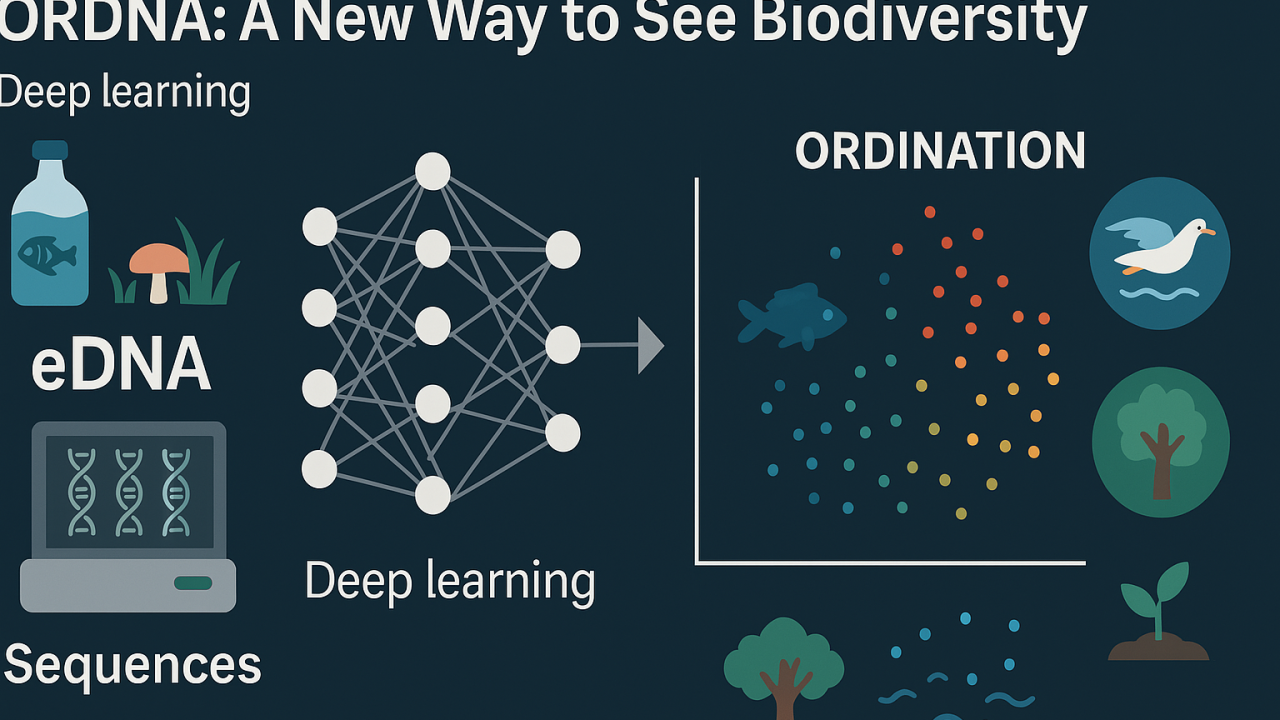
    ORDNA takes a different route. Instead of refining or trimming the data before analysis, it processes raw eDNA sequences as they are. The key is self-supervised learning (SSL), a cutting-edge subset of machine learning designed to extract meaningful information from unlabelled data. The central concept within ORDNA is the “triplet loss” function. In simple terms, triplet loss places samples with similar genetic reads closer together in a new, low-dimensional space and pushes apart those that differ.

    By performing this analysis directly on raw data, ORDNA preserves delicate genetic signals often lost in standard workflows. The result is an ordination (or “map”) of samples that better reflects how species clusters align with real-world ecosystems. This efficient, more faithful representation of biodiversity is a significant step forward, as it can reveal subtle distinctions between different sites or times that older methods might miss.

    Validating ORDNA: A Global Dataset Perspective

    To test its value, the research team used ORDNA on four distinct datasets from different ecosystems. Each dataset posed a unique challenge, and ORDNA consistently matched or outperformed standard ordination tools like Principal Coordinates Analysis (PCoA).

    Freshwater Samples from French Guiana: The first dataset looked at fish eDNA in rivers using a 12S rRNA gene fragment. By focusing on raw sequence data, ORDNA teased out a smooth biodiversity gradient from river sources to downstream regions. Traditional approaches, by contrast, sometimes produced fragmented patterns, possibly reflecting the loss of subtle details in standard data processing.

    Marine Samples from Brittany, France: Over three years (2020–2022), researchers collected marine eDNA to check for shifts in species composition. After ORDNA was trained on the 2020 data, it was able to project the following years’ samples onto the same “map”, revealing changes in ecosystem structure over time. This ability to handle time-series data without re-training a model from scratch can help scientists track evolving environmental threats.

    Forest Soils Across Switzerland: Forest ecosystems contain intricate webs of life, from fungi and insects to microbes. Soil eDNA was taken from both managed forests and more untouched reserves. ORDNA reliably grouped samples according to how they were used and maintained. Most managed forests were distinguishable from forest reserves, showcasing how ORDNA can highlight the impacts of human activity.

    Mercury-Polluted Soils in Visp, Switzerland: This last dataset examined soils contaminated with mercury. ORDNA revealed distinct spatial patterns that correlated with pollution levels. In fact, it better separated contaminated sites from cleaner ones than PCoA, indicating it might be especially sensitive to environmental gradients like pollution levels.

    Across all four examples, ORDNA either matched or surpassed standard ordination methods in illustrating real ecological transitions. Its non-linear “maps” captured subtle signals that might otherwise have gone unnoticed.

    What Makes ORDNA Different?

    Several features set ORDNA apart from established techniques:

    Avoiding Data Loss: By skipping regular steps like denoising or alignment with reference databases, ORDNA minimises the loss of rare or delicate signals. Traditional techniques risk discarding potentially useful information in an effort to remove noise.

    Non-Linear Embeddings: Methods like PCoA often rely on linear assumptions that are not well-suited to complex genetic data. ORDNA’s deep learning architecture reveals non-linear links, painting a more accurate picture of ecological patterns.

    Adaptability to Different Habitats: ORDNA has already shown promise in various settings: tropical rivers, ocean samples, forest soils, and polluted sites. This flexibility means it can be used in multiple conservation and research efforts without needing major changes.

    Time-Series Analysis: Once ORDNA is trained on a set of data, fresh samples can be quickly placed on the existing “map”. This feature is invaluable when tracking seasonal changes or monitoring areas over several years, as researchers do not have to start from scratch every time.

    Fast Projections: Though training a deep learning model can require powerful computers or GPUs, the finished model runs quickly on new data. This allows researchers to analyse eDNA in near real-time once the system is set up.

    Where ORDNA Could Improve

    Like all new tools, ORDNA has its limits. One drawback is the intense computational cost of training. Another challenge is the occasional appearance of “circular” patterns in the embeddings, which may stem from how the model generalises the data. Researchers are looking to refine ORDNA’s architecture and learn more about its behaviour under different conditions.

    There is also a wider question of explainability in deep learning. Many neural network approaches are criticised for being “black boxes,” making it hard for researchers to see why ORDNA arranges samples the way it does. Building in features that clarify which parts of the genetic data have the most influence could boost trust in the tool among ecologists and policymakers.

    Potential Directions for Future Research

    As ORDNA evolves, several areas stand out for further development:

    Bigger, More Varied Datasets: Using larger and more varied collections of eDNA—covering more taxa, primer sets, and sequencing platforms—could strengthen ORDNA’s overall performance. More diverse training data often leads to more robust machine learning models.

    Integration with Other Analysis Tools: The embeddings generated by ORDNA might serve as inputs for other methods. For example, ecologists could use these embeddings in species distribution models or network analyses to explore relationships between species in even greater detail.

    Deployment for Non-Experts: Making ORDNA easier to use for people outside data science—such as conservation workers, policymakers, and land managers—would broaden its reach. User-friendly interfaces and automatic pipelines could allow real-time decision-making in the field.

    Clearer Interpretations: As interest in “explainable AI” grows, future versions of ORDNA might highlight which DNA sequences drive patterns. This clarity could help ecologists identify the key genetic markers that signal ecological changes.

    Real-World Benefits for Conservation and Management

    The main appeal of ORDNA is its direct insight into raw eDNA data. By capturing ecological nuances that might be flattened or removed in standard workflows, it paves the way for more targeted conservation measures. For instance, a polluted site may harbour resilient but less apparent species that traditional pipelines overlook. ORDNA’s sensitivity could reveal these survivors, guiding strategies for restoring the habitat.

    In freshwater or marine environments, where conditions can change quickly, ORDNA can spot small shifts in biodiversity from one year to the next. These shifts might be warning signs of overfishing, climate change, or invasive species. With near real-time updates, agencies could act faster to curb harmful activities or protect key habitats. Over the long term, governments and NGOs might use ORDNA as part of larger programmes that take global snapshots of biodiversity, pinpointing risk zones before it is too late.

    In forest ecosystems, soil eDNA often holds clues to management practices and conservation outcomes. By revealing how logging or urban development impacts local species, ORDNA could help policymakers strike a better balance between economic interests and ecological integrity. Similarly, in heavily industrialised locations, ORDNA can measure how well remediation efforts are working by comparing fresh data with historical baselines.

    Towards a Deeper Understanding of Life on Earth

    ORDNA signals a leap forward in our ability to interpret eDNA data, showing just how powerful AI can be when applied to ecology. By working with raw sequences, it captures the full complexity of ecosystems, helping us see how species communities interact and respond to pressures like pollution, habitat loss, or climate change. Though it is still young and subject to improvement, ORDNA exemplifies how technology can drive ecological research in new, more revealing directions.

    One of the biggest challenges facing researchers, conservation groups, and governments is how to keep pace with the rapid changes battering our planet. Tools like ORDNA could be vital in mapping and monitoring these shifts at speed. As it matures, we may see a time when conservationists in the field collect soil or water samples, feed them into a user-friendly ORDNA system, and get immediate, detailed biodiversity readings. That immediacy could inspire faster, evidence-based action to protect threatened habitats and species.

  • Finding Dicistroviruses- An Origins Story

    Finding Dicistroviruses- An Origins Story

    Have you ever sat in an airport lounge, gazing out at the runway, and found yourself marvelling at just how quickly the world can change? That was precisely my mood yesterday at Heathrow as I prepared to depart for Kenya. My companions and I, from Kenyatta University, are about to embark on an exciting endeavour—using environmental DNA (eDNA) techniques to track mango and avocado pollinators and link their vital role to improved crop productivity.

    It is a moment that reminds me of a similar journey a little over a decade ago when I was at Cambridge University. Back then, eDNA was still in its infancy, though its foundational technologies—like virus metagenomics—were already showing promise. I remember the thrill of my first real foray into genomics and the sheer power of high-throughput sequencing, even if it did feel rather like peering into a crystal ball.

    Fifty-two weeks ago, I set out to share my readings on biodiversity research, initially with a focus on the Global South but gradually spanning the entire globe. Throughout this series, eDNA has taken centre stage—especially when paired with high-throughput sequencing and artificial intelligence—offering a treasure trove of insights: monitoring biodiversity at scale, tracking pests and diseases in crops and livestock, managing invasive species, verifying the authenticity of biological products, unravelling the interactions between plants and insects, and even ensuring safe drinking water. The past 52 weeks have been a constant reminder to me, and perhaps the reader of this newsletter, that the well-being of our planet and ourselves is inextricably linked.

    This is the 52nd entry in the series, and in many respects, it feels like I have come full circle—right back to where the story started, ready to begin the next chapter.

    November 2014.

    My PhD mentor, Professor John Carr and I were raring to go. It would be our first fieldwork experience since I began my PhD at the University of Cambridge in the Molecular Virology Lab. We were on a virus discovery mission and primarily looking to catch viruses transmitted by aphids. We already knew that aphids were responsible for spreading most plant viruses affecting crops, including beans. This mission was to investigate whether aphids flying around in fields carry and transmit multiple plant-infecting viruses. The thought that aphids could serve as ‘dirty hypodermic needles’ is a scary prospect for farmers and researchers. We were keen to know the diversity of aphid species in the field and the viruses they spread. At Heathrow Airport, John turned to me and said, ‘Look, Francis, it is going to be a long flight with dodgy aeroplane food; we may as well have a champagne breakfast before bingeing on movies.’ I could not agree faster.

    Our hosts in Kenya were scientists at the Biosciences Eastern and Central Africa Hub (BecA-ILRI) at the International Livestock Research Institute (ILRI). I had worked at ILRI as a research assistant before joining Cambridge University. James Wainaina, then a research assistant working on aflatoxins, joined John and me for the fieldwork. He had the social capital we needed. Over time he had forged strong connections with the Kenya Agricultural and Livestock Research Organization and a host of farmers who grew beans. James was about to leave for his PhD studies in Australia. His research interest was whiteflies on beans, which created a perfect convergence of our scientific interests.

    Our journey took us to Katumani and into the bean fields. However, we were two weeks early. There were hardly any aphids in the area. Usually, aphids accumulate on beans as they flower and pod. At times, they can be found in younger plants, but this was not the case at Katumani. Curiously, whiteflies were all over the place, which was great for James’ work. With not much to find, we headed for Kaiti in Makueni- a richly agricultural county in Eastern Kenya. Beans and cowpeas (Vigna unguiculata and locally called ‘kunde’) were plentiful. There were no aphids on the bean crop there, either. Instead, in our wandering through cowpea plots, we found plenty of other closely related species of aphid (the cowpea aphid), which was not what we wanted, save for scientific curiosity. It was a brutal initiation into fieldwork for John and I.

    The following morning, we set out for the highlands of Kiambu to a farmer called Njiiri, where his wife received us. It was a smallholder farm in the classic sense, optimised to produce as much crop variety as possible. Sweet potato, maize, kale, tree tomato, and the occasional beehive thrived alongside bean plots. Aphids were all over the place. Though we were happy to find aphids, Njiiri’s wife was not pleased. From the level of aphid infestation, it was apparent that she was not keen to spray to kill the aphids. Some of the plants showed signs of disease. It may have been that either the pesticides were financially inaccessible or undesirable environmentally. Notably, part of her farmland was leased to other farmers who also did not use pesticides and whose cultivated plots would continue to be a source of aphids and infection. As we were about to leave, she asked us in the precise way that farmers always speak, ‘Will I harvest anything on those bean plots, or do I just uproot everything?’.

    It was a poignant moment. Our next words were chosen carefully. We could tell the crop was lost to both disease and aphid infestation but had to hedge our words and actions to blunt the sharp edge of our assessment. So we said, ‘Look, we have trampled all over your shamba, mama. Surely, anything you would have harvested here is almost gone. We are more than happy to compensate you in cash for allowing us to work in your bean plots’. Her smile indicated to us that she understood what we implied. She would buy fresh seed and have another go the following season. Over that week, we found similar success in trapping aphids in smallholder farms in Oloirien and Oloolua in Kajiado. We also found despondency in farmers caused by insect and virus burdens- their efforts would not translate into bumper harvests.

    Back at the Beca-ILRI hub, we prepared the samples for High Throughput Sequencing on the Illumina Platform. Like all ‘clever-thinking’ scientists, we had a fair expectation of what we would get, but nature is full of surprises. I was back in the UK when the findings came through.

    Yes, insect-vectored plant viruses were detected, but plenty of sequences were annotated as ‘Aphid lethal paralysis virus’ and ‘Big Sioux River virus’. We had found dicistroviruses.

    Dicistroviruses are remarkable insect-infecting viruses; they use plants as reservoirs to infect their insect hosts. They can, in some cases, kill aphids, decrease their reproduction, or cause confusion, which predisposes aphids to attacks by predators and parasitoids. Concurrently, another researcher based in the UK detected similar and related viruses in maise while searching for components for maise lethal necrosis disease, which at the time was wreaking havoc for maize farmers in East and Central Africa. This finding of dicistroviruses was the first report of these viruses in the black bean aphid globally.

    I would go on to design research to explore the use of these potentially beneficial dicistroviruses for crop protection (bio-control). Funded through a Royal Society FLAIR Fellowship, I hoped to put a halt to aphid infestation and secure better yields for farmers by protecting crops without wrecking the environment. The work began in June 2019 at the International Centre of Insect Physiology and Ecology (icipe) in Nairobi, Kenya. icipe is a storied, one-of-a-kind organisation with a rich history of research in entomology to address grower challenges. I was looking to dig for the long haul, build collaborations, establish a research group, make discoveries, and translate those into solutions.

    Then, suddenly, the covid pandemic struck, and the world stopped.

    When we re-emerged, the world was different; the cost of sustaining the research proved a mile too far for the funding agency. John would carry on the research at Cambridge. I moved to the UK and joined Niab as a Research Leader In Entomology.

    Niab is very big on applied entomology, and I quickly noticed that my skillsets could help advance the fortunes of growers, especially with pest identification and monitoring. Identification of cryptic insects using traditional methods is difficult, fault-prone for non-specialists, tedious and very difficult to scale. DNA-based tools are a modern and efficient solution. Pretty soon, this has gravitated to environmental DNA as an important tool for this work. The more I study the eDNA method, the more I am fascinated by its versatility in answering questions across different spheres, be it plant health, biodiversity, one health, pests, diseases, or plant-insect interactions.

    So here we are.

    In the coming weeks, I will share more about the eDNA project in Kenya as well as other exciting advancements in the 52 Science Stories space. Stay in touch for the next ‘52’.