
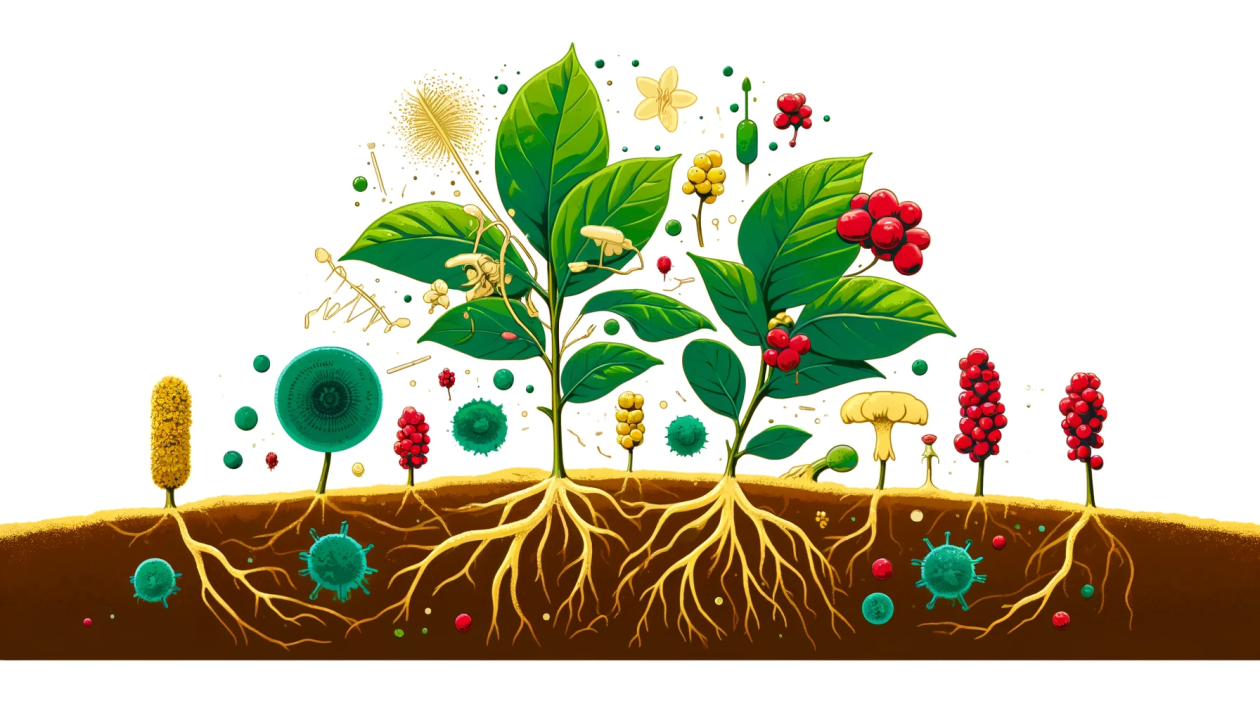
Trichoderma species, ubiquitous in various soil types and ecosystems worldwide, are known for their roles as primary decomposers, producers of antimicrobial compounds, and biocontrol agents against diverse plant pathogens. These fungi can inhibit the growth of harmful pathogens through parasitism, the release of chemicals to inhibit the growth of pathogens (antibiosis), and competition for resources. Moreover, some Trichoderma species enhance plant growth and nutrient uptake, making them invaluable in agriculture. Despite their global significance, the diversity and distribution of Trichoderma in Africa, particularly within coffee ecosystems, remains understudied. This article shares a study where the researchers explored the biodiversity of Trichoderma species in Ethiopian coffee plants, aiming to find potential candidates for managing coffee wilt disease (CWD) caused by the fungus Fusarium xylarioides.
Ethiopia, the birthplace of Arabica coffee, is Africa’s largest coffee producer and the world’s fifth-largest coffee exporter. Coffee cultivation supports the livelihoods of approximately 4.5 million farmers. However, the sector is underproductive due to fungal and bacterial diseases. These diseases are made more severe by climate change. CWD, in particular, has become a significant issue, not just in Ethiopia but also in surrounding East African countries. The annual yield losses attributed to CWD are estimated at 30-40%. Traditional methods of managing CWD, such as uprooting infected plants and using resistant varieties, have proven inadequate. Given the economic importance of coffee, exploring alternative management strategies is essential.
Trichoderma Isolation and Identification
To explore the diversity and distribution of Trichoderma species in Ethiopia’s coffee-growing regions, soil samples were collected from ten major coffee-growing areas covering different agro-climatic zones. Researchers collected soil samples from the zone of soil surrounding a plant root where the biology and chemistry of the soil are influenced by the root (the rhizosphere) of coffee plants in ten major Ethiopian coffee-growing areas. The soil samples were processed to isolate Trichoderma species using Trichoderma Specific Medium and purified by subculturing on potato dextrose agar.
Fusarium xylarioides, the causative agent of CWD, was used as a test pathogen to evaluate the biocontrol potential of Trichoderma species. The isolates were classified and identified at the species level using physical characteristics and molecular techniques. Genomic DNA was extracted for molecular identification, and the TEF1-α region was amplified using specific primers. The degree of dominance index was used to categorise the habitat preference of Trichoderma isolates in the coffee rhizosphere.
The Diversity of Trichoderma in Ethiopian Coffee Regions
The study identified 175 Trichoderma isolates from 184 soil samples. Molecular identification based on TEF1-α sequences classified the isolates into 16 putative species. Nine of these isolates were novel observations for Trichoderma species in Ethiopia. The study also found that the diversity of Trichoderma species varied geographically. The highest species diversity and evenness were recorded in the forest and semi-forest coffee ecosystems of Kaffa, Jimma, and Bale. The forest ecosystem had the highest isolation frequency of Trichoderma species, followed by the semi-forest and garden coffee ecosystems, most commonly practised by smallholder farmers.
Trichoderma as Potential Biocontrol Agents
Trichoderma species were tested for their ability to inhibit the mycelial growth of F. xylarioide fungus- the causative agent for CWD. The results were promising. Twelve isolates exhibited the highest level of antagonistic activity, with inhibition percentages ranging from 44.5% to 84.8%. The most effective isolates, T. asperellum AU71, T. longibrachiatum AU158 and T. asperellum AU131, were subjected to secondary metabolite extraction. The crude metabolites from these isolates significantly inhibited the growth of F. xylarioides. Field and greenhouse experiments were also conducted to evaluate the effectiveness of Trichoderma under real-world conditions. The findings highlighted the challenges of biocontrol agents adapting to local environmental conditions. However, the research demonstrated that native Trichoderma isolates, being well-adapted to local climates and pathogenic targets, hold considerable promise for sustainable coffee farming.
Future Prospects and Applications
Exploring Trichoderma diversity in Ethiopia marks a significant step towards sustainable coffee cultivation. This very timely study gives insights into the biodiversity and biocontrol potential of Trichoderma species in Ethiopia’s coffee ecosystems. These findings provide a foundation for developing effective strategies against CWD. Leveraging the natural biodiversity of Trichoderma can lead to more sustainable and resilient agricultural practices. Further research on characterising the secondary metabolites produced by Trichoderma species could provide new ways to protect coffee against fungal pathogens under different environmental conditions. The impact of finding a sustainable and climate-smart solution to coffee fungal disease on the millions of smallholder farmers cannot be overestimated. Importantly, this study highlights the untapped potential within our ecosystems, emphasising the need for further exploration of soil microorganisms and plant health to achieve sustainable agriculture and environmental conservation.
Leave a Reply