
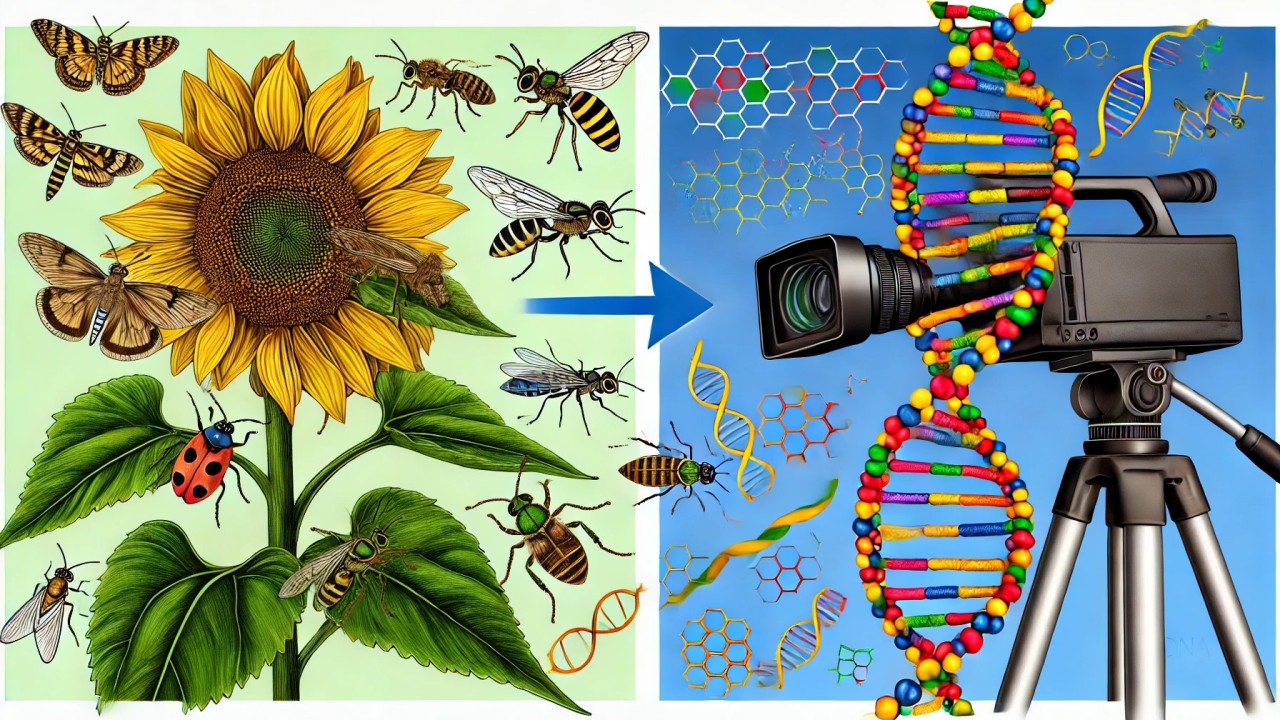
Environmental DNA (eDNA) metabarcoding has emerged as a promising tool for detecting interactions between insects and plants. However, observation-based verification of eDNA-derived data is still required to confirm the reliability of those detections. A recent study aimed to address this by comparing eDNA metabarcoding with video camera observations to detect insect communities associated with sunflowers (Helianthus annuus). For those new to the terms ‘environmental DNA’ and ‘metabarcoding’- environmental DNA refers to genetic material obtained from environmental samples, such as soil, water, or, in this case, plant surfaces, without capturing the organisms themselves. Metabarcoding is the process of extracting and analysing this DNA to identify multiple species from a single sample rapidly.
The researchers explored several hypotheses in their study. They aimed to verify the reliability of eDNA metabarcoding in accurately recovering insect interactions with plants, as observed through video recordings. Additionally, they tested the effectiveness of prewashing flower heads before eDNA sampling to determine if this method could effectively remove prior eDNA, ensuring that only new interactions were captured. Finally, they investigated potential biases in eDNA detection—specifically, whether eDNA metabarcoding tends to favour detecting certain types of interactions, such as those involving plant sap-sucking species, which could lead to the underrepresentation of other taxa like transient pollinators.
How the Study Was Conducted
The researchers studied insect interactions with sunflowers by combining field experiments, video recordings, and environmental DNA (eDNA) analysis. They chose a sunflower field because the large flower heads make it easy to observe insect activity. Five cameras recorded the interactions from 9 a.m. to 5 p.m. The sampling was conducted during dry and sunny weather, and there was no precipitation on the days of sampling.
To focus on new insect visits, they prewashed 21 sunflower heads with deionised water using a handheld sprayer before filming. After recording, the researchers cut off the sunflower heads using clean stainless-steel scissors. They placed the flower heads in a plastic bag on dry ice while still in the field and then transferred them to a lab. To check for any contamination during sampling, they filled one plastic bag with 100 millilitres of deionised water from the sprayer used in the field. In the lab, they extracted DNA by rewashing the flower heads to collect any insect DNA left behind.
Finally, they compared the data from the videos and the eDNA analysis using statistical methods to see if both methods provided similar results. This approach allowed them to validate their findings and understand the advantages and limitations of using eDNA metabarcoding compared to direct observation when studying how insects interact with plants.
Discoveries and Insights
Both methods revealed distinct arthropod communities, with approximately 25% overlap between the species detected. Notably, eDNA metabarcoding identified a broader range of arthropod families, particularly rare species that were not frequently observed in the videos. Conversely, video observations captured more frequent interactions. This suggests that eDNA might be more effective at detecting less common species that could be missed by visual observation. However, the eDNA method showed a bias towards detecting plant sap-sucking species, likely due to their longer contact periods with the plant, resulting in more significant eDNA deposition.
Additionally, the study revealed that prewashing the sunflower heads did not completely remove existing eDNA traces, indicating that genetic material may persist longer than previously thought. This persistence needs to be considered when interpreting eDNA results.
Implications for Future Research and Conservation
These findings have significant implications for biodiversity monitoring and conservation. By uncovering the often-invisible connections between plants and insects, eDNA metabarcoding provides a deeper understanding of ecological networks. The study underscores the complementary strengths of eDNA metabarcoding and video observations in tracking insect-plant interactions. While each method offers distinct insights, their combined use gives a fuller picture of these relationships, allowing researchers to capture a broader range of species and interactions, which improves the accuracy of biodiversity assessments.
Future research should focus on refining the integration of these methods by developing standardised protocols to enhance the detection of both rare and common species. Further investigation into eDNA persistence on plant surfaces and calibrating eDNA detection with video-observed interaction durations could improve result interpretation. Expanding this combined approach to other ecosystems, alongside using machine learning to automate video analysis, would enhance efficiency and accuracy. Ultimately, improving these techniques will lead to more robust biodiversity monitoring and a deeper understanding of plant-insect dynamics, strengthening conservation and agricultural efforts.
Leave a Reply