
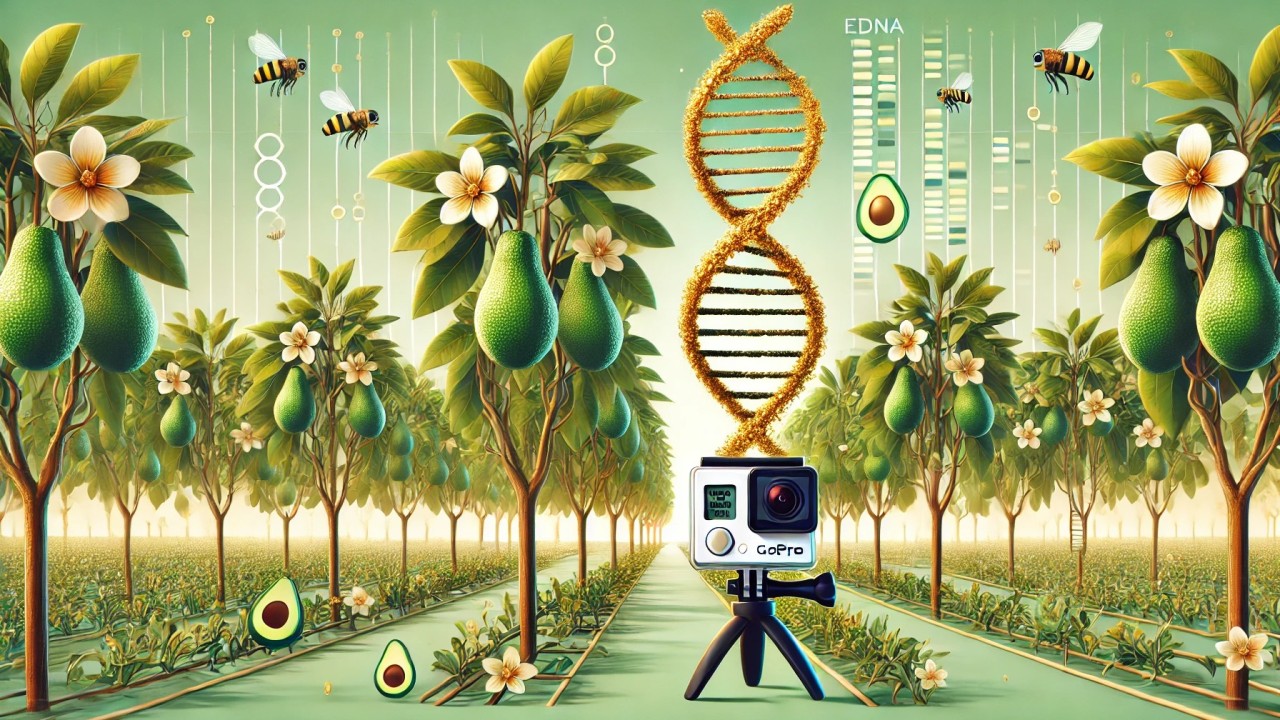
Sustainable agriculture relies on effectively managing both beneficial and harmful interactions between crops and their environment. Technological innovations in biodiversity monitoring—such as digital video recordings (DVRs) and environmental DNA (eDNA) metabarcoding—are transforming our ability to monitor arthropod activity in farming systems. Arthropods play a dual role in agriculture: they contribute to pollination, pest control, and ecosystem health, but also to herbivory and disease spread. Beneficial species like honeybees and wild pollinators are vital for consistent yields in many crops, while pests, pathogens, and invasive species pose significant risks to global food supplies. Integrated monitoring is essential to balance these interactions, especially amid increasing stressors like habitat loss, pesticide use, and climate change.
Modern Alternatives- DVRs and eDNA
Before technological advancements, arthropod monitoring heavily relied on conventional methods such as sweep netting and visual observations. These approaches often require intensive manual labour and expert identification, posing challenges for large-scale agricultural systems. Digital video recordings have emerged as a valuable tool for tracking flower-visiting arthropods, successfully documenting visitation behaviours and capturing multiple interactions simultaneously.
However, DVRs have limitations. They are less effective in identifying small or cryptic species and cannot monitor nocturnal insects. In response, new molecular techniques like eDNA metabarcoding have gained traction. This method uses DNA from flowers or other substrates to reveal the arthropod taxa present, capturing both large-scale and fine-scale interactions within orchards. A recent study compares these two methods in revealing plant-insect interactions in Avocado orchards.
What is eDNA and Why Does It Matter?
Environmental DNA (eDNA) refers to trace genetic material left behind by organisms in their environment—whether in soil, water, or air. When coupled with metabarcoding, this molecular tool can amplify and sequence DNA fragments, providing rich taxonomic insights unattainable through traditional methods. For agriculture, this means a deeper understanding of the dynamic and often complex interactions between crops and arthropods.
How was the study conducted?
Inflorescences were collected from two ‘Hass’ avocado orchards, Marron Brook Farm (MB) and Bendotti Avocados (BA), located in the Manjimup-Pemberton region of southwest Western Australia. This region is characterised by agricultural lands interspersed with remnants of native karri forest. MB orchard, situated approximately 200 meters above sea level, comprises ‘Hass’ trees interspersed with ‘Fuerte’ pollinisers, while BA orchard, located about 16 kilometres south-southwest of MB at 138 meters above sea level, cultivates only ‘Hass’ trees.
To assess the arthropod communities visiting the avocado flowers, eight ‘Hass’ trees of similar age and height were randomly selected in each orchard. Ten inflorescences were collected from each tree during both low and peak flowering periods in 2020, with samples taken evenly from the upper and lower canopies to minimise bias.
In the laboratory, each eDNA sample was assessed using quantitative PCR targeting the Cytochrome Oxidase 1 (CO1) gene, a standard marker for arthropod identification due to its variability among species. Replicate amplifications were pooled and sequenced using an Illumina MiSeq platform.
Simultaneously, digital video recordings (DVRs) were employed to visually monitor arthropod visits to the flowers. GoPro cameras were mounted on stands to observe two inflorescences per tree in the lower canopy, capturing time-lapse images to maximise battery life. Recordings were made during optimal weather conditions for bee activity to ensure representative sampling of pollinator visits.
DNA Analysis Reveals Diverse Arthropod Presence on Avocado Flowers
The eDNA analysis revealed a diverse array of arthropods on the avocado flowers, identifying 60 different taxa across 42 families. Common detections included potential pest species like thrips, beneficial pollinators such as the honeybee (Apis mellifera), and possible plant parasites. On average, each flower sample contained DNA from about two arthropod species.
In contrast, the video recordings observed 23 taxa across 22 families visiting the flowers. The most frequently seen visitors were hoverflies, honeybees, and blowflies. Out of over 15,000 recorded flower visits, the majority were made by hoverflies, followed by honeybees and blowflies.
Flowering Intensity, Canopy Position, and Orchard Location Affect Findings
Statistical analyses indicated that the diversity of arthropods detected through eDNA varied with flowering intensity, canopy position, and orchard location. Significant differences were found in the detection of certain groups, such as flies and bees, between low and peak flowering periods and between the two orchards. Notably, samples from the upper canopy had higher detection rates for bees, wasps, and other arthropods compared to those from the lower canopy.
Video observations also showed significant changes over time and between orchards. The number of arthropod visits recorded increased markedly from low to peak flowering in both orchards, especially at the MB orchard. Hoverflies showed the most significant increase during peak flowering, particularly at MB. Visits by honeybees and other flies also increased notably in this orchard, while the BA orchard showed smaller changes.
No Link Found Between Arthropod Size and DNA Detection Probability
Contrary to expectations, the study found no link between the size of an insect and its likelihood of being detected through eDNA. It was initially thought that larger insects might leave more DNA on flowers, increasing their chances of detection. However, results suggested that detection depends more on how insects interact with the flowers—such as which parts they touch—rather than their size.
The Importance of Combining eDNA and Video Observations for Comprehensive Monitoring
The study highlights the value of combining eDNA analysis with video observation methods for comprehensive monitoring. While eDNA provided a broad overview of the insect community, detecting many species missed by video recordings—including small or nocturnal insects—the videos captured detailed information on insect behaviour and abundance. For example, videos observed species like hoverflies in large numbers that were less prominent in eDNA results. Together, these methods offer a more complete understanding of the interactions between crops and arthropods, enabling better-informed management decisions.
Integrating eDNA Metabarcoding into Natural Capital Accounting
Quick and accurate detection of both beneficial and harmful insects is essential for sustainable agriculture and the valuation of ecosystem services. This study demonstrated that eDNA metabarcoding could be a valuable tool for natural capital accounting in agroecosystems. By regularly monitoring the presence of pollinators, pests, and predators, eDNA analysis can help quantify ecosystem services like pollination and biological pest control.
Integrating eDNA monitoring into agricultural practices allows for the development of metrics that assess ecosystem health and biodiversity. These metrics can be communicated to farmers to inform management decisions that balance productivity with conservation. For example, understanding the diversity and abundance of pollinators and predators can encourage farming practices that reduce pesticide use and promote beneficial insects.
Future improvements in eDNA technology, such as advanced sequencing methods and multiple genetic markers, can enhance detection accuracy, including rare or emerging pest species. While eDNA provides detailed species information, combining it with traditional methods like video observations ensures a more comprehensive understanding of the insect community.
Leave a Reply