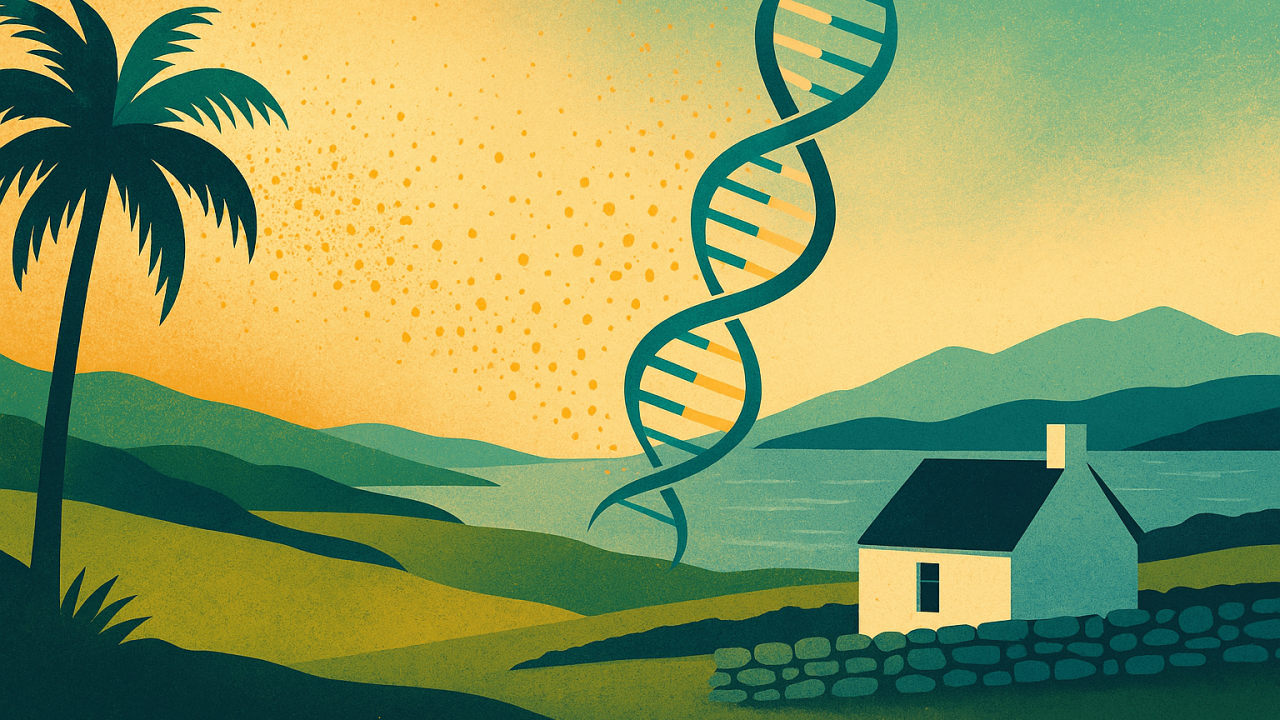
Every breath we take carries invisible traces of life. Fragments of DNA shed by people, plants, animals, fungi, and microbes drift through the air, unnoticed yet abundant. What if we could capture that genetic dust and read the story it holds? A recent study explores exactly this.
By applying shotgun sequencing to airborne environmental DNA (eDNA), researchers show that it is possible not only to catalogue biodiversity but also to trace populations, track pathogens, and even detect genes linked to antibiotic resistance — all from samples of air.
The work was conducted in the forests and beaches in Florida and urban centres and mountains in Ireland. These locations offered a natural laboratory to ask a bold question: can the air itself serve as a global archive of genetic diversity?
Why Airborne eDNA Matters
Conservationists are racing against time. Biodiversity is being lost at an unprecedented rate, while climate change, invasive species, and new pathogens are shifting the distribution of life across the planet. Traditional field surveys often struggle to keep pace with these changes, especially for elusive or nocturnal species.
eDNA has already revolutionised biodiversity monitoring in water and soil, where organisms leave behind genetic traces. Air, however, is a more challenging medium: particles are sparse, dispersed, and easily degraded. Until recently, studies focused mainly on metabarcoding — sequencing short “barcode” fragments of DNA to confirm which species are present.
This new research pushes further. By using shotgun sequencing, which reads across whole genomes rather than just short barcodes, the team recovered information-rich datasets from the air. These contained not only species identities but also genetic variation within populations, viral strains, resistance genes, and much more.
Capturing the Air: Study Locations and Methods
Between 2022 and 2024, the researchers collected airborne DNA from a wide range of settings:
- Florida, USA – a hammock coastal forest, beaches, and mixed residential sites along the Gulf Coast.
- Ireland – Dublin city centre, mountain ridges, estuaries, and rural locations.
For comparison, they also gathered DNA from water, soil, beach sand, and even windowpanes where airborne particles naturally accumulate.
Air was sampled in several ways: by vacuum pumping air through fine filters, passively exposing filters to natural airflow, or swabbing surfaces where airborne particles had settled. Some samples ran for just hours; others collected DNA over weeks or even months.
Once in the laboratory, DNA was extracted and sequenced using two leading technologies: long-read sequencing (Oxford Nanopore) and short-read sequencing (Illumina). Both were paired with cloud-based bioinformatics tools to speed up analysis. Remarkably, the entire process — from collecting a sample to obtaining results — could be achieved in just two days by a single researcher.
From Bobcats to Bees: Wildlife Genetics in the Air
One of the study’s most striking findings is that even large, wide-ranging animals leave enough genetic traces in the air to study their populations.
In Florida, for instance, DNA fragments from a bobcat (Lynx rufus) were captured in forest air samples. Analysis revealed that this bobcat’s genetic profile clustered with wild and zoo bobcats from northeast Florida — information usually obtained from scat or tissue samples. Similarly, DNA from the golden silk orb weaver spider (Trichonephila clavipes) allowed the team to trace its relationship to other North American populations.
Even entire mitochondrial genomes of species such as moths were recovered from single airborne DNA reads. This demonstrates that air sampling can support population genetics — the study of genetic differences within and between populations — a task once thought impossible without physical specimens.
Human DNA and Ethical Questions
Not surprisingly, human DNA was also abundant in the samples, particularly in city air. In Dublin, researchers detected dozens of distinct human mitochondrial haplotypes, reflecting the city’s diverse population.
The recovery of detailed human genetic data raises urgent ethical and legal questions. Unlike wildlife, humans have clear rights to genetic privacy. The study emphasises that policies are urgently needed to decide when and how human eDNA should be analysed, and who should be allowed to do so.
Pathogens and Resistance Genes: Health in the Air
Beyond wildlife, the study highlights the potential of airborne eDNA for pathogen surveillance. Viral genomes were recovered in detail, including avian viruses and even cowpox. In Dublin’s city air, more than 200 species with pathogenic potential for humans were detected.
Crucially, genes linked to antimicrobial resistance (AMR) were found across all sample types — air, water, and sand. AMR is one of the World Health Organization’s top global health threats, making the ability to monitor resistance genes in real time a major breakthrough.
The air also carried DNA of mosquitoes, midges, and rats — key vectors of human diseases. This opens the door to early-warning systems for vector-borne outbreaks.
Pests, Pollinators, and Food Webs
The air’s genetic record extends to agriculture too. Pest species such as cockroaches, termites, and fire ants were detected, as were crop pathogens like Alternaria alternata, a fungus harmful to plants and people alike.
Yet not all signals were bad news. Pollinators, including bumblebees and honeybees, were present in several samples. Importantly, DNA from bees and their parasitic mite (Varroa destructor) was found together, offering a way to monitor pollinator health and threats simultaneously.
In Florida forests, the air revealed entire food webs — from predators like bobcats and rattlesnakes to their prey, and from trees to the insects that feed on them. This ecological fingerprinting shows the richness of information contained in just a week’s worth of air sampling.
Air versus Water and Soil: Which Works Best?
Interestingly, air samples often contained higher proportions of animal DNA than water or sediment. While sand proved rich in microbial and marine DNA, air appeared particularly powerful for detecting terrestrial species, especially arthropods (insects, spiders, and their relatives).
When shotgun sequencing was compared directly to metabarcoding, it proved far more balanced. Metabarcoding sometimes exaggerated certain species (such as the northern cardinal bird) while missing others entirely (like the American alligator). Shotgun sequencing, by contrast, recovered a truer picture of the species present.
Towards Real-Time Biodiversity Monitoring
The researchers also streamlined DNA extraction from air, reducing it from hours to minutes without losing data quality. Combined with portable sequencers and cloud-based pipelines, this points towards a future of near real-time biodiversity monitoring.
Imagine forest rangers detecting invasive pests as soon as they arrive, public health officials spotting a dangerous viral variant in city air, or conservationists tracking endangered species without ever laying eyes on them. The possibilities are vast.
The Bigger Picture: Opportunity and Responsibility
This study demonstrates that the air around us is not empty, but a living archive of genetic information. From Dublin’s streets to Florida’s forests, it holds the signatures of species, populations, pathogens, and even our own DNA.
The potential applications are enormous:
- Conservation – monitoring elusive species and fragile ecosystems.
- Agriculture – detecting crop pests and resistance genes.
- Health – tracking pathogens, allergens, and vectors.
- Forensics – applying genetic insights to law enforcement.
- Drug discovery – mining microbial genomes for new medicines.
Yet with this power comes responsibility. The ability to recover human genetic data from outdoor air demands urgent ethical guidelines and regulatory frameworks. Like artificial intelligence, airborne eDNA is a technology that must be shaped for the public good.
Every gust of wind carries a hidden library of DNA. Thanks to advances in sequencing, we now have the tools to read it. The air, it turns out, is more than what we breathe. It is a shared genetic commons, connecting species and environments in ways we are only beginning to understand. Harnessing this knowledge wisely could help us face some of the greatest challenges of our time, from biodiversity loss to global pandemics.
Leave a Reply