Forests play a pivotal role in carbon sequestration, biodiversity conservation, and the provision of economic resources. However, plant pests and pathogens pose significant threats, resulting in billions of dollars in annual losses and reducing the effectiveness of forests in mitigating climate change. Traditional forest health surveillance, which relies largely on visual inspection, often detects disease only after substantial spread has occurred. This delay in detection highlights the urgent need for innovative technologies that enable sustainable and proactive forest protection. A recent study illustrates how environmental DNA (eDNA) offers groundbreaking possibilities for early pathogen detection, saving time and costs while improving eradication outcomes.
Understanding Environmental DNA (eDNA)
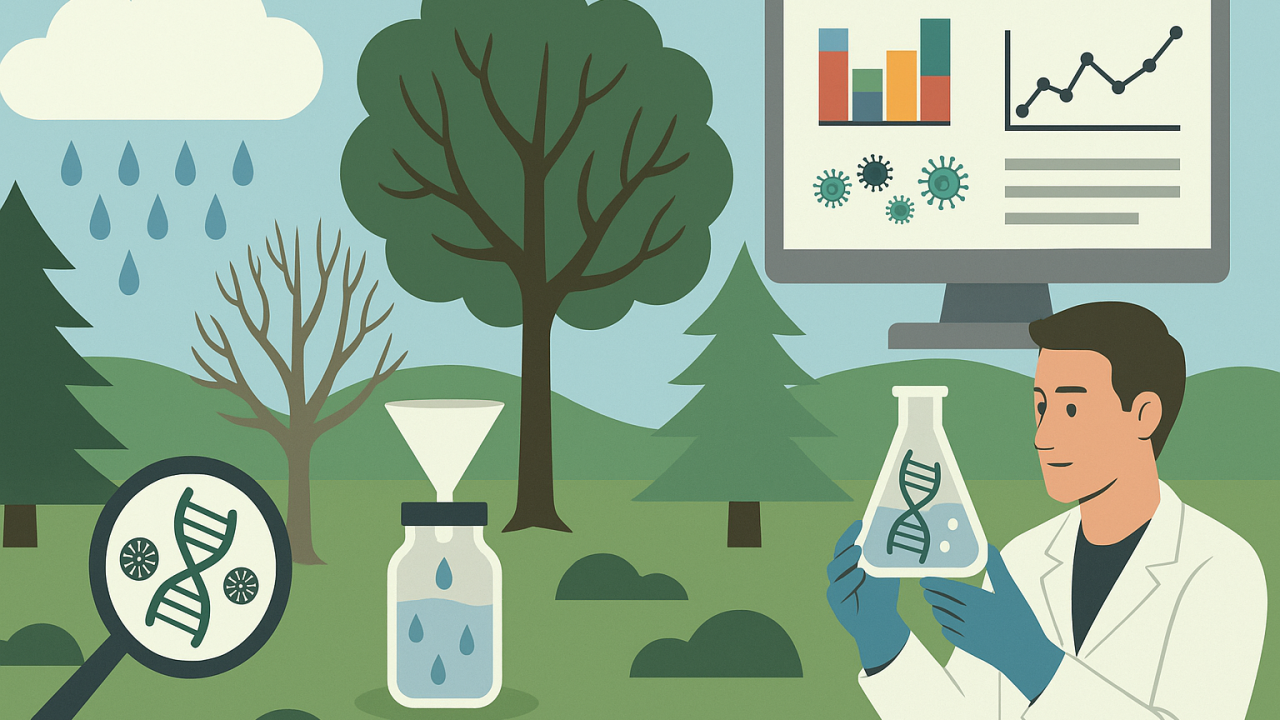
Environmental DNA refers to genetic material shed by organisms into their surroundings, detectable in rainwater, soil, or air samples. It provides a snapshot of biological diversity, allowing for the detection of organisms before visible signs of their presence emerge. In this study, rainwater samples collected from forest sites in Northern Ireland were analysed to detect fungal and oomycete pests, demonstrating the viability of eDNA for forest health monitoring.
Rainwater Sampling Across Northern Ireland’s Forests
The study gathered data from five forest sites: Lough Navar, Davagh, Loughgall, Hillsborough, and Mount Stewart. These sites were selected to represent a range of forest types, from dense spruce and pine monocultures to mixed recreational areas containing oak, ash, and beech. Environmental conditions, including rainfall and temperature, were also recorded to contextualise the findings.
Rainwater traps were strategically placed beneath different tree species—oak, pine, spruce, and ash—as well as in open fields. Over 12 months, scientists collected 480 rainwater samples. Filtering and DNA extraction were performed using advanced techniques to maximise recovery and preservation of genetic material.
From DNA to Detection: Advanced Analytical Techniques
The captured eDNA was analysed using metabarcoding, a next-generation sequencing (NGS) approach targeting specific genetic markers, such as the ITS1 region. This technique enabled the identification of fungal and oomycete pests with high precision. Unlike traditional PCR, which requires prior knowledge of the target organism, NGS offers the capacity to detect both known and previously unrecorded pests—transforming early detection capabilities.
Raw DNA sequences were processed through custom-built bioinformatics pipelines on high-performance computing systems. Tools such as QIIME2 and ANCOM-BC were employed to classify sequences, normalise data, and reveal significant patterns in pest diversity and abundance across different trees, sites, and seasons.
Key Findings
Analysis of the data revealed the presence of 65 fungal and oomycete pests within the rainwater samples, nine of which appear on the UK Plant Health Risk Register. Notably, two pests—Gnomoniopsis idaeicola and Sirococcus piceicola—were detected for the first time in Northern Ireland.
The highest number of pest detections occurred in November, with autumn emerging as the most active season for fungal and oomycete pests. However, pest diversity peaked during both summer and autumn, reflecting the life cycles of many fungi, which tend to fruit and sporulate during these periods.
Some pests exhibited clear preferences for particular tree species or sites. For example, Monochaetia monochaeta was found exclusively beneath oak trees, while pine tree traps captured pathogens associated with needle diseases. Interestingly, field traps—positioned away from tree cover—recorded the highest diversity of pests, likely due to exposure to wind-blown spores.
The Case for Early Detection
Early detection remains critical for containing plant pests before they cause irreversible damage. By deploying eDNA surveillance, authorities can drastically shorten response times for pest management. The study highlighted pests such as Verticillium albo-atrum, harmful to fruit and ornamental plants, and Colletotrichum acutatum, a threat to celery and strawberries, both of which were associated with high risk scores—underscoring the necessity of swift intervention.
Recognising the Challenges
Despite its promise, the application of eDNA for forest health surveillance is not without limitations. Primer selection in metabarcoding can bias detection; for instance, some Phytophthora species known to exist in these forests did not appear in the dataset, likely due to primer mismatch. Furthermore, existing taxonomic databases such as UNITE remain incomplete, often preventing full resolution of species identities. Environmental variables also introduce complexity, as wind and rain may transport DNA from distant sources, making it harder to localise pest origins precisely.
Future Directions
While the study marks a significant step forward, further developments are needed to fully harness the potential of rainwater eDNA for forest health monitoring. Expanding the range of substrates tested—incorporating soil, leaf litter, and airborne eDNA—could broaden the spectrum of pests detected. Enhancing genetic reference libraries by incorporating data from lesser-known and emerging pests will improve identification accuracy. Ultimately, tailoring sampling strategies to the life cycles of pests and their host trees will enable a more targeted and comprehensive pest profile.
Implications for Forest Management
The integration of eDNA into forest surveillance offers a robust, proactive tool for safeguarding ecosystems. By enabling earlier detection, it reduces the costs associated with managing established outbreaks. It also enhances ecological security by safeguarding the ecosystem services that forests provide, including carbon storage, biodiversity support, and soil stability. Moreover, the method is scalable and could be adapted to track bacterial and insect pests alongside fungal and oomycete threats.
Environmental DNA metabarcoding has thus emerged as a transformative approach for forest health surveillance. Offering early, accurate, and broad insights into pest presence, it empowers authorities to act swiftly and decisively. This study demonstrates not only the feasibility but also the profound potential of rainwater eDNA monitoring in modern forest management. As methods and databases advance, eDNA could become a cornerstone of resilient, future-ready strategies for protecting forests in a changing world.
Leave a Reply