
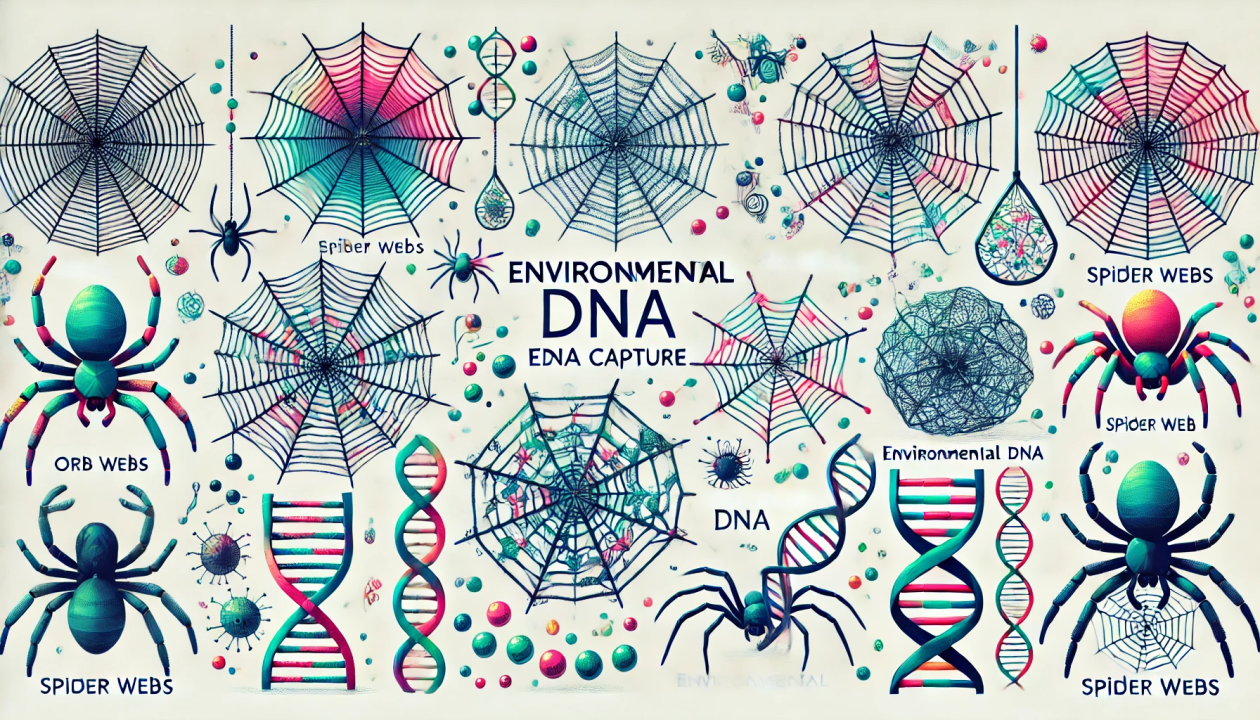
This week’s article shares another study that has explored the innovative use of spider webs as biofilters to collect environmental DNA (eDNA) for insects and broader biodiversity monitoring. As the natural world continues to face unprecedented levels of biodiversity loss, capturing accurate and comprehensive data on the state of ecosystems has become crucial. Traditional biodiversity assessment methods, reliant on taxonomic species identification through morphological and behavioural traits, have shown significant limitations—mainly concerning inefficiencies and invasiveness. Innovative molecular techniques, especially eDNA sampling, present a promising solution. eDNA involves collecting and analysing genetic materials shed by organisms into their environments, providing a non-invasive means of tracking biodiversity across different ecosystems.
Spider Webs: Natural Air Filters with Great Potential
Spider webs are ubiquitous and diverse, making them ideal candidates for eDNA sampling. Spiders are dominant predators in arthropod communities, and their webs—ranging from orb webs to sheet webs—capture a wide array of airborne particles. This unique ability positions spider webs as natural, non-invasive samplers of eDNA, potentially revolutionising biodiversity monitoring. The study employed a combination of single-species detection and multi-species metabarcoding to evaluate the efficacy of spider webs as eDNA samplers.
Single-Species Detection
The researchers conducted field tests using two different spiders and theie webs. One was the Garden spider Araneus diadematus, which builds a two-dimensional orb web, consisting of nonsticky, as well as sticky threads. The other was the Common hammock weaver Linyphia triangularis, which builds a sheet web in the form of a three-dimensional hammock-like segment, interlaced with a looser mesh of silk above without any sticky capture threads. The researchers introduced small house crickets (Acheta domestica) into the webs as prey and later collected the webs containing no visible prey remains. They designed two assays targeting different ‘genetic fingerprints’ to validate prey detection. The researchers found that the collected webs, even those without visible prey remains, successfully revealed the presence of house cricket DNA even when diluted 10-fold. These results demonstrated that different types of spider webs efficiently capture eDNA, regardless of the web’s structural or adhesive properties.
A Multi-Species Metabarcoding Approach
To gauge the broader applicability of webs in biodiversity monitoring, metabarcoding protocols were established. Over two years, web samples from the two spider species were collected across two distinct forest types in Slovenia (submediterranean and continental). High-throughput sequencing was performed using primers targeting specific ‘DNA fingerprints’ for animals (COI), fungi (ITS), and bacteria (16S rRNA). Among these, they could taxonomically assign many reads for bacteria, fungi, and animals. Alpha diversity, which measures the variety of species within a specific habitat or ecosystem, varied significantly between web types for bacteria and fungi but not for animals. Sheet webs accumulated a higher diversity of bacterial and fungal eDNA compared to orb webs. Beta diversity measures, which compare community compositions across samples, showed that web type, sampling locality, and year all significantly influenced community compositions for bacteria, fungi, and animals. Notable detections included plant pathogens, disease-causing fungi, medically important bacteria, and several pollinator species. The study also found groups of organisms that co-occur in known parasitic and mutualistic relationships. Intriguingly, spider webs captured extensive “aerial plankton” comprising a multitude of life forms, emphasising their utility as widespread biodiversity samplers.
Implications for Biodiversity Monitoring and Future Directions
Spider webs are effective eDNA samplers capable of capturing a broad spectrum of biodiversity from their environment. The findings underscore the utility of spider webs in non-invasive, detailed biodiversity monitoring suitable for tracking various organism groups across time and space. The implications of these findings have some key takeaways:
Non-Invasive Biodiversity Monitoring: Spider webs offer a non-invasive, passive method of collecting eDNA, thus minimising any potential harm to ecosystems and organisms.
Temporal and Spatial Data: Regular and consistent collection of spider webs can provide invaluable temporal and spatial data, aiding in the detailed monitoring of biodiversity changes over time.
Broad Taxonomic Coverage: Spider webs capture eDNA from a wide array of organisms, including bacteria, fungi, arthropods, and even potentially plants and viruses, providing comprehensive snapshots of ecosystem biodiversity.
Practical Applications: Beyond academic research, eDNA from spider webs can be used in various practical scenarios. For instance, it can aid in detecting invasive species, monitoring pest populations, and conducting environmental impact assessments for conservation projects.
Implementing spider webs as a standard eDNA sampling method could significantly enhance ecological and conservation research, offering a powerful tool for comprehensive biodiversity assessments. However, challenges remain. The variable preservation of eDNA depending on environmental conditions and potential biases during DNA amplification, are aspects that need consideration. Future research should focus on refining laboratory techniques, establishing standardised protocols and exploring the potential of pooling samples from multiple webs to increase detection power or investigate the longevity of eDNA on long-lasting web types.
Leave a Reply