
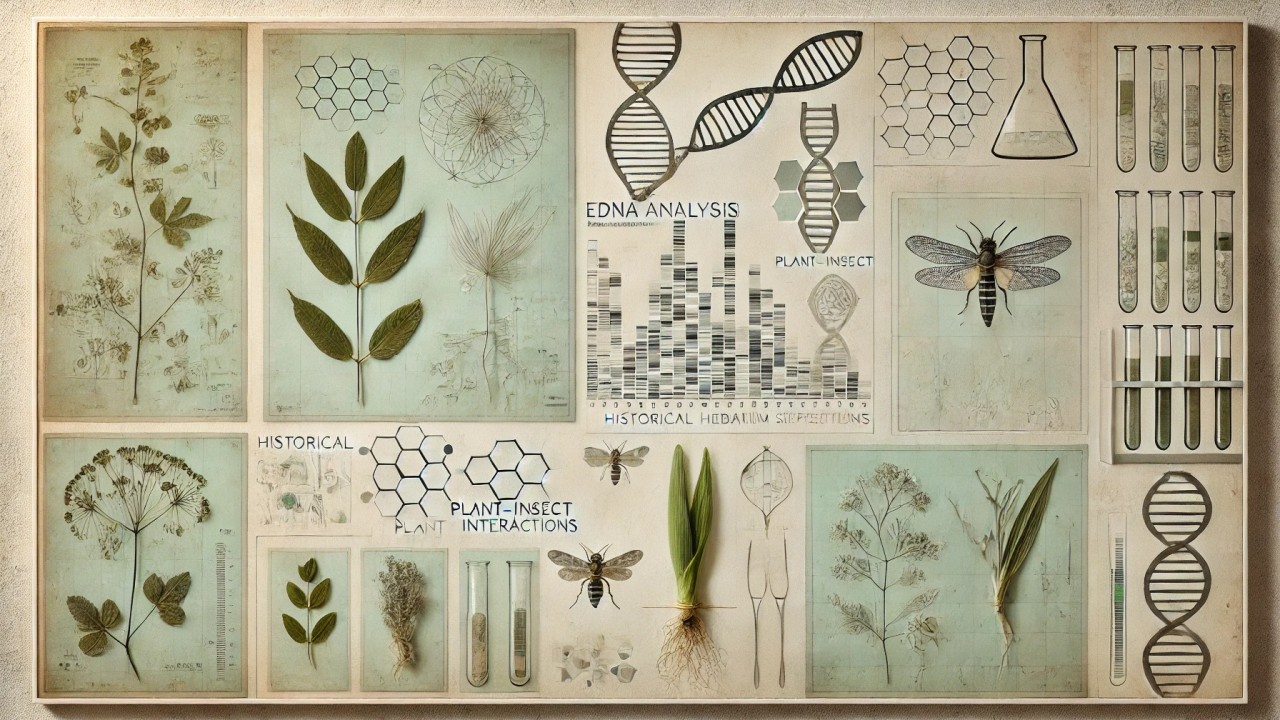
Imagine walking into a room filled with carefully preserved plant specimens, some dating back centuries. These collections, known as herbaria, have long been treasure troves for botanists studying plant evolution and taxonomy. However, recent research has uncovered an unexpected bonus hidden within these dried leaves and flowers – a snapshot of the intricate world of plant-insect interactions frozen in time. A ground-breaking study has demonstrated that traces of insect DNA left behind on plants can be detected and analysed even decades after the specimens were collected. This discovery opens up exciting new possibilities for understanding how ecosystems have changed over time and how plants and insects have co-evolved.
Herbarium Specimens: Time Capsules of Biodiversity
Herbaria worldwide house millions of plant specimens collected and preserved over centuries. Stored under dry, dark conditions, herbarium specimens not only preserve plant DNA but also environmental DNA from insects that interacted with them— which can be extracted and analysed. Research shows that typical storage conditions do not significantly affect the arthropod diversity detectable in these samples, making herbaria crucial for studying the evolution of plant-insect interactions over time. The research team in this study examined herbarium specimens from three different sources:
Iranian Herbarium (est. 2017): This herbarium, the most recent among the three, was housed at the University of Isfahan in Iran. It contained specimens of Calotropis procera (Giant milkweed/ Sodom apple), a widespread species in southern Iran. Researchers selected 19 specimens, each around six years old at the time of laboratory analysis, focusing on flowers and leaves to extract arthropod DNA. This institutional herbarium served as a standardised baseline for protocol development aimed at recovering arthropod eDNA from well-preserved plant specimens.
German Herbarium (est. 2005): Compiled by one of the researchers as part of their university curriculum, this private Herbarium from Western Germany included various plant species representative of the region. Stored in a private household for 18 years, this collection helped explore a broader spectrum of plant-insect associations by sampling from ten plant species across six families.
German Herbarium (est. 1963): Assembled by a pharmacy student during her studies, this collection from Northern Germany dated back 60 years. It also offered a variety of plant specimens from the region, allowing the analysis of plant-insect interactions from the mid-20th century. Despite the age of these specimens and prolonged storage in private settings, researchers successfully extracted arthropod DNA, highlighting the longevity of eDNA in herbaria specimens when properly preserved.
Revealing Plant-Insect Relationships Through Environmental DNA (eDNA)
The scientists used a technique called environmental DNA (eDNA) metabarcoding to analyse the genetic material left behind by insects on the plant specimens. This method allows researchers to identify multiple species from a single sample, providing a comprehensive picture of the insect community associated with each plant. Their findings were fascinating:
Diverse insect communities: One of the most striking aspects of the findings was the broad spectrum of arthropod diversity recovered, including various types of herbivores, such as gallers, miners, chewers, and sap-suckers. Among these, sap-sucking arthropods were particularly well-represented, constituting approximately 39% of the total taxa identified. This abundance is likely due to their strong physical interaction with host plants, leaving ample DNA traces to be collected and analysed. Predators, parasitoids, and pollinators were also found among the recovered taxa, though pollinators were underrepresented. This was expected since their interaction with plants is typically brief, resulting in less DNA being deposited compared to herbivores that spend the majority of their lifecycle on the host plants.
Ecological specificity: Ecological specificity refers to how distinct insect communities associate with particular plant species or different parts of a plant. The researchers found that distinct insect populations were associated with specific plant species, as evidenced by the different taxa found on various plant samples from the same Herbarium. There was minimal overlap among the communities, indicating a high degree of ecological specificity and minimal DNA transfer between samples. Moreover, even within a single plant, different compartments, such as flowers and leaves, were shown to have distinct interacting arthropod species. For example, in specimens of the Iranian plant Calotropis procera, flowers and leaves exhibited varied compositions of associated arthropod communities. While some taxa overlapped, many were uniquely found either on flowers or leaves indicating specialised interactions that occur at this level.
Geographic accuracy: A significant finding was that the geographic origins of the arthropod DNA matched the regions where the plants were originally collected, underscoring the accuracy and reliability of this method for ecological studies. This indicates that the content of these specimens is reflective of actual historical interactions rather than contamination over the years.
Specialised interactions: The researchers identified several arthropods exclusively associated with specific host plants. For instance, species like the gall midge Asphondylia sarothamni and the false flower beetle Anaspis rufilabris were found on particular European plants, while the Plain tiger butterfly Danaus chrysippus was associated with the Iranian plant Giant milkweed Calotropis procera. These discoveries highlight the specialised feeding and life cycle behaviours of these arthropods, which have evolved alongside their host plants. Moreover, the study revealed detailed multi-tiered ecological interactions, such as the tri-trophic relationship observed with the Willow-carrot aphid Cavariella aegopodii and its parasitoid, the braconid wasp Binodoxys brevicornis, feeding together on ground elder (Aegopodium podagraria). This level of specificity and interaction complexity is crucial for understanding the delicate balance within ecosystems and the potential impacts of environmental changes.
Challenges and Innovations in Analysing Historical Specimens
Working with historical specimens presented unique challenges that the researchers had to overcome. One significant challenge was dealing with the potential degradation of DNA over time, particularly in older specimens. DNA can degrade due to environmental factors and storage conditions, leading to reduced diversity and community representation in older samples. To address this, the researchers employed short DNA fragments to ensure more robust data recovery from older samples. Another challenge was the cross-contamination of samples, as the provenance and long-term storage conditions of herbaria could result in synanthropic pests—species commonly found in storage environments—contributing extraneous DNA. The team implemented stringent sampling and processing protocols, including rigorous sterilisation of equipment and controls to mitigate contamination risks. Additionally, the task of differentiating genuine plant-associated arthropod DNA from that of contaminants required careful analysis and ecological validation of recovered taxa, considering their geographic and ecological appropriateness.
Implications for Understanding Biodiversity Changes
One of the most exciting applications of this research is its potential to track changes in insect communities over time. The team demonstrated this by analysing archived leaf samples from a 20-year forest monitoring project in Germany. Using data from the Forest Condition Survey in Saarland, the researchers studied European beech samples collected consistently from six sites between 2004 and 2021. This extensive dataset provided a unique opportunity to examine long-term biodiversity patterns. Through eDNA metabarcoding, they tracked fluctuations in arthropod communities, revealing a significant rise in species richness between 2004 and 2006, followed by stabilisation. This finding suggests that forest ecosystems may experience more stable diversity over time, in contrast to rapidly changing grassland environments. The study highlights the importance of long-term monitoring in understanding ecosystem health and biodiversity dynamics.
The Future of Ecological Research Using Herbaria
This innovative approach to studying historical plant-insect interactions has the potential to revolutionise our understanding of ecosystem changes over time. Some key implications and future directions include:
Expanding the temporal scale: By applying these techniques to even older herbarium specimens, researchers may be able to study ecological relationships spanning centuries.
Global comparisons: With herbaria located worldwide, scientists can now compare plant-insect interactions across different regions and time periods, providing insights into global patterns of biodiversity change.
Monitoring invasive species: Historical specimens could reveal when and where invasive insect species first appeared in new regions, aiding in understanding their spread and impact.
Conservation planning: By understanding how plant-insect relationships have changed over time, conservationists can make more informed decisions about ecosystem management and species protection.
Climate change research: Analysing historical specimens could provide valuable data on how climate change has affected plant-insect interactions over the past century.
As we face unprecedented global changes, the ability to look back in time through the lens of herbarium specimens offers a unique and powerful tool for ecological research. By combining cutting-edge DNA analysis techniques with the foresight of botanists who carefully preserved plant specimens over decades and centuries, we gain a clearer picture of the complex and ever-changing relationships between plants and insects. This research not only highlights the enduring value of natural history collections but also demonstrates how new technologies can breathe fresh life into historical specimens, unlocking secrets of the past to inform our understanding of the present and future of Earth’s ecosystems.
Leave a Reply