
Pest outbreaks can quickly turn into major economic losses if they are not identified and managed early. One of the most challenging pests in citrus farming is the Japanese orange fly (Bactrocera tsuneonis). This pest is particularly difficult to detect because its larvae develop hidden inside mandarin oranges. Recent research exploring environmental DNA (eDNA) has opened a promising avenue for early detection in agricultural settings, offering a non-destructive and efficient alternative to traditional methods.
Understanding the Japanese Orange Fly
The Japanese orange fly is a pest that mainly targets mandarin oranges. Its life cycle is closely linked to the seasonal rhythm of citrus orchards. During the summer months, adult female flies lay their eggs in immature fruits. Once the eggs hatch, the larvae grow concealed within the fruit until they are ready to leave and pupate in the soil during early winter. Because the larvae develop inside the fruit, any damage is often only discovered after the infestation has already caused significant harm.
Traditional detection methods have generally relied on visual inspections and the use of bait traps. However, these methods come with several drawbacks. Visual inspections require expert knowledge and are time-consuming; they often miss early signs of infestation since the damage occurs internally. Bait traps, which typically use chemical attractants such as methyl eugenol, are also ineffective for the Japanese orange fly, as this species does not respond well to such lures. Consequently, there is an urgent need for a detection method that can signal the presence of the pest before it becomes too late for effective intervention.
The Promise of eDNA in Pest Management
Environmental DNA, or eDNA, has emerged as a revolutionary tool in pest management. The basic concept behind eDNA is that organisms leave behind traces of genetic material in their environment. In the case of Japanese orange fly, this DNA can be deposited on the surface of fruits during activities such as mating behaviour or even incidental licking. Researchers have now demonstrated that by simply rinsing the surface of mandarin oranges with water, it is possible to collect samples that provide evidence of the pest’s presence even when traditional indicators, such as oviposition pinholes, are absent.
This approach has significant advantages. By detecting even minute amounts of genetic material, the eDNA method allows for earlier and non-invasive surveillance of pest populations. Instead of waiting for physical signs of infestation or employing labour-intensive trap surveys, farmers can now potentially monitor orchards more proactively, catching infestations while they are still in their initial stages.
How eDNA Detection Works
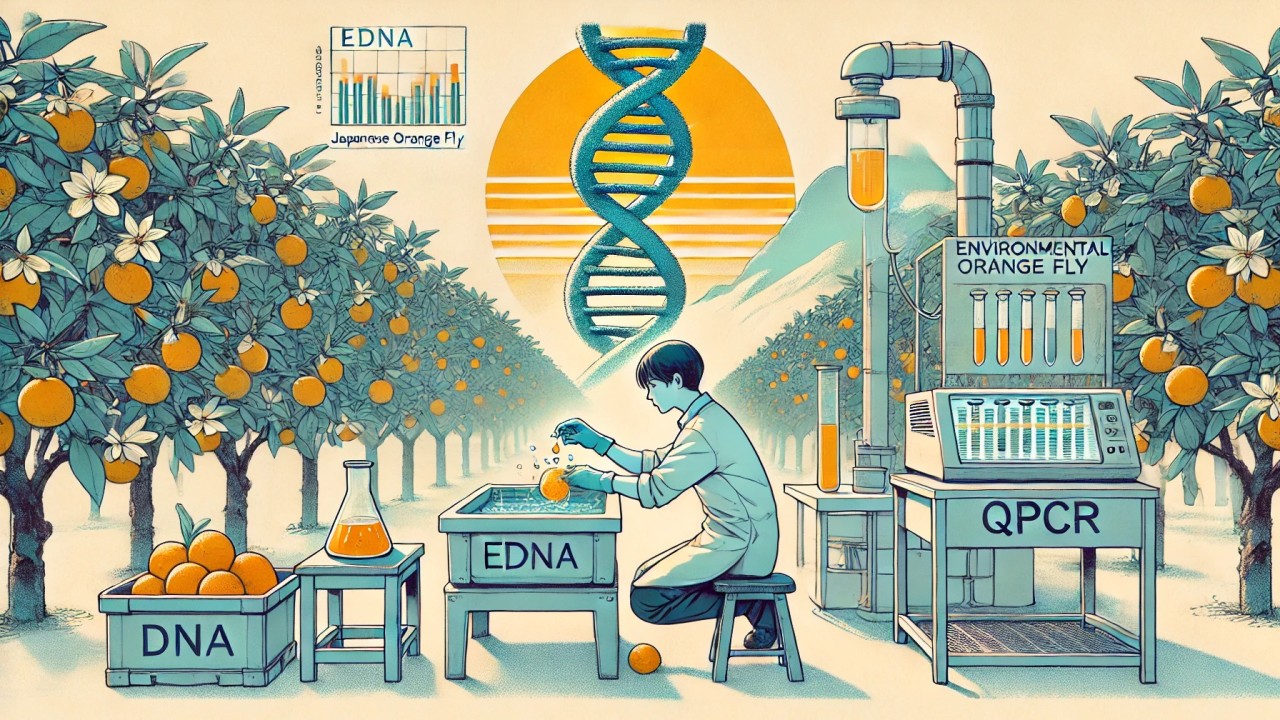
The eDNA detection process is both innovative and straightforward. It begins with the careful collection of mandarin oranges from the orchard. Farmers or researchers take great care to avoid contaminating the fruit with extraneous DNA. This typically involves wearing clean gloves and using sterilised plastic bags to handle the fruit, ensuring that only the natural DNA present on the fruit’s surface is collected.
After the fruits are gathered, they are placed in a container with distilled water. The fruits are then left to soak for a specified period, during which any traces of pest DNA present on their surfaces are washed off into the water. The next step is to filter the water to capture the DNA fragments. A specialised filter, such as a Sterivex filter, is used for this purpose. Once the water has been filtered, the DNA trapped on the filter is extracted using standard DNA extraction kits.
The final stage of the process involves analysing the extracted DNA using quantitative real-time polymerase chain reaction (qPCR). This advanced method amplifies even the tiniest quantities of DNA, making it possible to detect the genetic material left by the pest. Researchers have designed specific primers and fluorescent probes that target a mitochondrial gene unique to the Japanese orange fly. This design ensures that the detection method is both sensitive and highly specific, eliminating the risk of cross-reactivity with other organisms.
Field Testing and Practical Results
Field tests provided strong evidence supporting the effectiveness of eDNA-based detection for the Japanese orange fly. Early experiments concentrated on fruits that already exhibited visible signs of infestation, such as small pinholes created by egg deposition. When these fruits were rinsed in water for one hour, about 20% showed detectable levels of pest DNA. When the rinsing period was extended to 18 hours, the detection rate increased to approximately 33%. Although the longer rinsing time did improve detection slightly, statistical analysis indicated that a one-hour rinse was generally sufficient for effective DNA extraction.
One of the most promising outcomes from the field trials was the ability of the eDNA method to detect the pest, even in fruits that appeared completely healthy. In a separate set of tests, approximately 10% of fruits with no visible signs of infestation still yielded positive results for the presence of Japanese orange fly DNA. This finding is significant because it demonstrates that the eDNA method can serve as an early warning system, alerting farmers to potential infestations long before any physical damage is visible.
To further improve efficiency, researchers also explored the technique of pooled sampling. In this approach, one fruit displaying obvious signs of pest activity was combined with four seemingly uninfected fruits in a single water immersion. Even with this mixed sample, the method was able to detect the presence of pest DNA. Pooled sampling is particularly advantageous for large orchards where testing each individual fruit would be impractical. However, this approach requires meticulous sample handling to minimise the risk of contamination between samples.
Field examinations conducted across various orchards reinforced the reliability of the eDNA method. In orchards with high pest densities, where adult Japanese orange flies were frequently observed, the detection rates in fruit samples ranged between 60% and 80%. Even in orchards where adult flies were not seen, the method detected eDNA in around 60% of samples, resulting in an overall average detection rate of approximately 65.7%. These consistent results suggest that eDNA analysis can reliably indicate pest presence, regardless of the density of adult flies in the area.
To further validate the findings, researchers performed sequence analysis on the PCR amplicons obtained from the samples. The sequences were then compared with known reference sequences of the Japanese orange fly. The high degree of similarity confirmed that the eDNA detected in the samples was indeed from the target pest, providing additional confidence in the method’s accuracy and reliability.
Advantages of eDNA in Pest Monitoring
The advantages of eDNA detection for Japanese orange fly go beyond just technical sophistication. It also offers transformative potential for agricultural pest management by:
Early Detection: Addressing infestations before populations grow large enough to cause significant damage.
Non-Destructive Testing: Unlike methods that require cutting fruits, eDNA is a minimally invasive process, preserving the integrity of the produce.
Adaptability: This method can be employed even in regions with low pest density or uncertain infestation status, offering more inclusive monitoring coverage.
Cost-Efficiency: By enabling pooled sampling of fruits, it decreases the time and resources needed for extensive trap surveys and visual inspections.
Implications for Agriculture and Future Advances
The introduction of eDNA technology into pest management practices represents a significant advancement for the agricultural industry. The Japanese orange fly has long been a problematic pest due to its concealed life cycle, and traditional detection methods have proven inadequate. With the advent of eDNA detection, farmers are now equipped with a powerful tool that enables them to monitor their orchards more effectively and respond to infestations before they escalate into serious issues.
Beyond citrus farming, the principles of eDNA detection have the potential to revolutionise pest management across a variety of crops. As research in this field continues to progress, similar methods could be developed to monitor other agricultural pests that have, until now, been difficult to detect using conventional techniques. This broader application could lead to a paradigm shift in agricultural practices, shifting the focus from reactive measures to proactive, early intervention strategies.
Moreover, in an era where food security and environmental sustainability are critical, the integration of eDNA detection into routine pest management could prove to be a game-changer. By empowering farmers with the ability to preempt pest outbreaks, this innovative approach promises to safeguard crops, protect livelihoods, and contribute to a more sustainable agricultural future.
Leave a Reply