
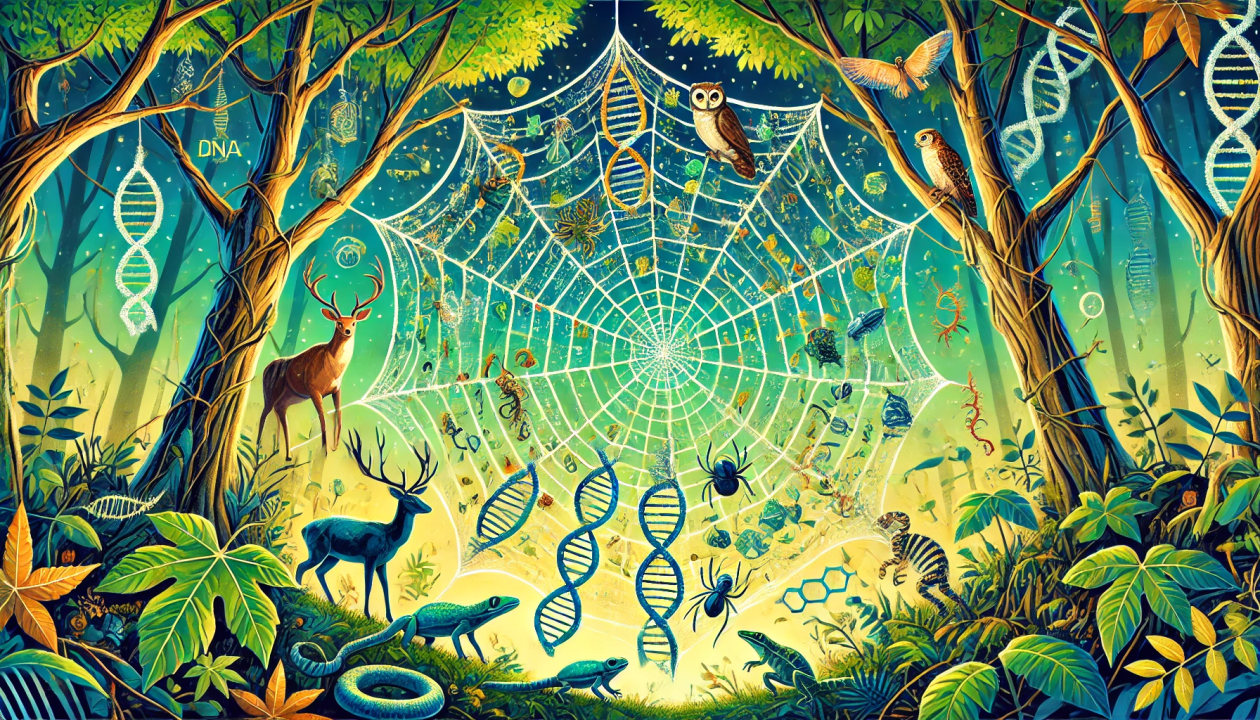
Have you ever stopped to marvel at the intricate beauty of a spider web? As it turns out, these silky structures are more than just bug traps – they may hold the key to revolutionising how we monitor and protect biodiversity. A groundbreaking study, has found that spider webs can capture environmental DNA (eDNA) from a wide range of animals, offering a simple yet powerful tool for assessing biodiversity. Every living thing, from the tiniest insect to the largest mammal, leaves traces of DNA in the environment via shed skin cells, hair, faeces and other biological material. This eDNA can be collected and analysed to detect what species are present in an area, without the need to physically see or capture the animals. While eDNA techniques have already been used to monitor species in aquatic environments, adapting the approach for terrestrial habitats has proved more challenging.
Spider Webs as Biofilters
That’s where spider webs come in. Spider webs, ubiquitous in many environments, serve as natural sticky traps, efficiently capturing organic materials, insects, and airborne particles. In a recent study, researchers in Australia hypothesised that the sticky strands could passively collect eDNA floating in the air or deposited by insects and other creatures that come into contact with the web. To test this, they collected spider webs from two locations in Western Australia – a wildlife reserve and a zoo. Using a metabarcoding approach, which involves sequencing DNA to identify different species, they analysed eDNA extracted from these webs.
The Impact of Biomass and Distance and a Localised Snapshot of Biodiversity
At Karakamia, a 268-hectare reserve teeming with native Australian wildlife, spider webs revealed the presence of 32 different vertebrate species, including mammals, birds, reptiles, and amphibians. Remarkably, the webs also picked up the DNA of invasive species, such as the red fox, providing valuable insights for conservation efforts. In contrast, the webs collected from Perth Zoo, a highly controlled environment with a known roster of animal inhabitants, yielded eDNA from 61 vertebrate species. This included a variety of exotic animals, reflecting the zoo’s diverse population.
The research highlighted a correlation between the biomass of animals and the likelihood of their DNA being detected in spider webs. Larger animals, with their greater shedding of DNA, were more easily identifiable. Additionally, proximity to the source of DNA—such as an animal’s enclosure—played a significant role in detection. Over 50% of detections came from within just 5 meters of an enclosure, although some, like the Asian elephant, left traces up to 195 meters. One of the key findings was that eDNA captured by spider webs provided a highly localised snapshot of the vertebrate community. This local focus is a significant advantage, as it means land managers could use spider web DNA to zero in on exactly what species are present in highly specific habitats. The technique could help monitor endangered species, detect invasive pests, and see how animals respond to changes in their environment over time – all with minimal disturbance to the creatures themselves.
An Effective Non-Invasive Monitoring Tool but with Its Limitations
The study demonstrated that spider webs could serve as cost-effective and non-invasive tools for monitoring terrestrial vertebrate biodiversity. This method requires minimal setup and can be deployed easily in both conservation areas and human-managed environments.
Like any scientific advance, there are some caveats. Different spider web types may vary in their ability to latch onto DNA. Environmental conditions like wind and temperature could impact how long DNA lasts on a web. While spider webs effectively capture local eDNA, understanding the source and movement of airborne eDNA remains challenging. This can lead to false positives where DNA is detected, but the animal is no longer present.
Nonetheless, there are implications for future research and use-case opportunities.
Conservation Efforts: This technique can help track endangered or protected species without disturbing their habitats.
Invasive Species Management: Early detection of invasive species can prompt timely and effective management interventions.
Biodiversity Monitoring: Spider webs provide an additional tool for comprehensive biodiversity assessments, complementing existing methods like camera traps and traditional surveys. Continued research is needed to determine how far eDNA can travel and its potential impact on accurate biodiversity assessments is needed.
For those interested in new frontiers of environmental science, the use of spider webs for eDNA collection promises an exciting and valuable addition to biodiversity monitoring and conservation efforts. This research demonstrates the tremendous potential of this innovative method for ecological monitoring. As we continue to refine and expand this approach, spider webs could become a standard tool in our eDNA monitoring toolkit, enhancing our ability to understand and protect the planet’s biodiversity.
Leave a Reply