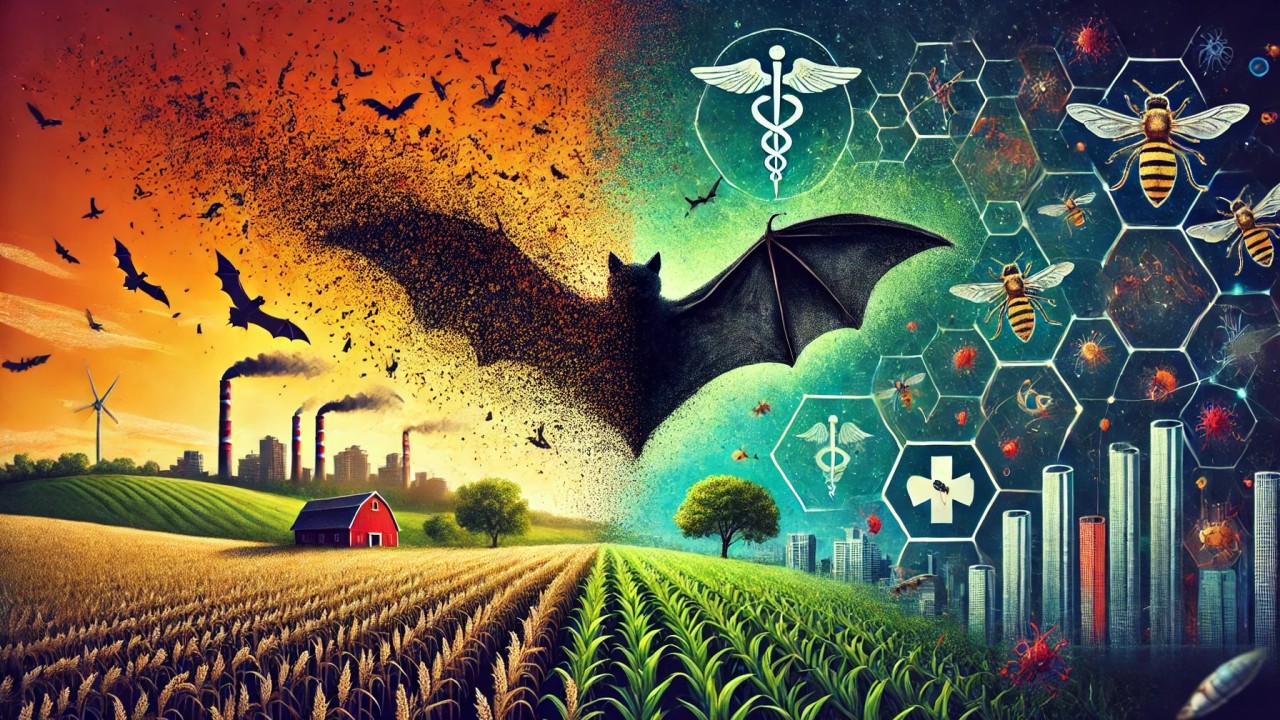
Biodiversity loss has accelerated in recent years, with potentially severe consequences for human well-being and economic systems. However, quantifying the precise costs of ecosystem disruptions has remained challenging for researchers. A new study published in Science provides compelling evidence for the significant economic and health impacts that can result from declines in key species populations. By examining the effects of bat population losses due to an emerging wildlife disease, the research demonstrates how ecosystem changes can have far-reaching consequences for agricultural practices and public health outcomes.
The Unexpected Experiment: White-Nose Syndrome in Bats
In 2006, researchers first detected white-nose syndrome (WNS) in bat populations in Albany, New York. This deadly fungal disease, caused by an invasive cold-loving fungus species (Pseudogymnoascus destructans), has since spread across much of North America with devastating effects. WNS disrupts bats’ hibernation cycles, causing them to prematurely awaken and deplete critical fat reserves. With mortality rates averaging over 70%, WNS has led to rapid declines and even local extinctions of bat populations.
The emergence and gradual expansion of WNS across the United States created what economists refer to as a “natural experiment” – an unexpected change in environmental conditions that approximates a randomised controlled trial. As the disease spread to new counties each year, it allowed researchers to compare outcomes before and after bat population declines across affected and unaffected regions.
This unique scenario enabled Dr. Eyal G. Frank of the University of Chicago to investigate a crucial question: How do farmers and ecosystems respond when a key provider of biological pest control – insect-eating bats – experiences dramatic population losses? The results provide empirical validation for longstanding theories about the economic costs of biodiversity decline and ecosystem disruption.
The Essential Role of Bats in Agriculture
Ecologists have long documented the vital role that bats play in controlling insect pest populations that damage crops. A single bat can consume up to 40% of its body weight in insects each night, including many agricultural pests. Previous field experiments preventing bats from accessing crop fields demonstrated significant increases in insect density and crop damage in the bats’ absence. Based on these observations, researchers predicted that declining bat populations would lead farmers to compensate by increasing their use of chemical insecticides. This study provides the first large-scale empirical evidence confirming this hypothesis.
Using county-level data on annual insecticide use, the research found that after the onset of bat die-offs due to WNS, farmers in affected counties increased their insecticide use by an average of 31.1% compared to unaffected counties. This substantial increase in chemical pesticide application represents a direct substitution of human-made inputs for the lost natural pest control services previously provided by healthy bat populations.
These results provide crucial empirical validation of a fundamental theoretical prediction in environmental economics – that declines in natural capital lead to compensatory increases in human-made substitutes. However, as the study goes on to show, this substitution can come with significant unintended consequences.
The Human Health Impact: Increased Infant Mortality
While increased insecticide use may help farmers maintain crop yields in the absence of biological pest control from bats, it also introduces new risks. Pesticides are toxic compounds by design, and their use has long been of concern to public health experts due to potential adverse health effects. To assess whether the compensatory increase in insecticide application had detectable health impacts, the study examined county-level data on annual infant mortality rates. The analysis revealed that after the onset of WNS and subsequent bat population declines, infant mortality rates due to internal causes (excluding accidents and homicides) increased by an average of 7.9% in affected counties compared to unaffected areas. This translates to approximately 0.54 additional infant deaths per 1,000 live births in WNS-affected counties. The study estimates that between 2006-2017, this amounted to 1,334 additional infant deaths attributable to increased pesticide exposure following bat declines.
As with the insecticide use data, there were no detectable differences in infant mortality trends between WNS-affected and unaffected counties prior to WNS emergence. The study also found no meaningful changes in other birth outcomes like birth weight or gestation length, which is consistent with prior research on environmental pollution effects.
These findings highlight that even when used within regulatory limits, real-world insecticide application levels can have detrimental impacts on human health. The results agree with previous estimates of environmental pollution effects on infant health from other contexts, lending further credibility to the causal interpretation.
The Economic Toll of Bat Die-offs
Beyond the direct costs of increased chemical inputs, the study also examined broader economic impacts on agricultural operations in WNS-affected areas. While the total land area under cultivation did not change significantly, there were notable effects on crop revenues and farm profitability. In the years following WNS detection, crop revenues in affected counties dropped by an average of $7,960 per square kilometre – a 28.9% decline relative to mean levels. This suggests that despite increased insecticide use, farmers were unable to fully compensate for the loss of biological pest control services provided by bats.
Interestingly, although insecticide use increased, overall chemical expenditures (including all agrichemical inputs) declined by 23.4% in WNS-affected counties. This somewhat counterintuitive finding likely reflects farmers optimising their input mix in response to changing conditions and lower crop revenues.
The study estimates total agricultural losses, including reduced crop revenue and changes in chemical expenditures, at $26.9 billion (in 2017 dollars) across all WNS-affected counties from 2006-2017. This substantial economic impact underscores the often-underappreciated value of ecosystem services provided by wildlife populations.
The Value of Healthy Ecosystems
This research provides compelling evidence for the substantial and often hidden costs that can result from biodiversity loss and ecosystem disruptions. By leveraging a natural experiment created by the spread of white-nose syndrome in bat populations, the study demonstrates how declines in key species can lead to increased chemical pesticide use, negative health outcomes, and significant economic losses in agricultural systems. The findings validate longstanding theoretical predictions about the importance of well-functioning ecosystems and the challenges of substituting human-made capital for lost natural inputs. They also highlight the complex interconnections between ecological, agricultural, and human health systems.
This research underscores the urgent need for evidence-based conservation policies that account for the full economic and social value of healthy ecosystems. By making these often-invisible costs more tangible, studies like this can help drive more informed decision-making around the critical trade-offs between economic development and environmental preservation. Ultimately, this work reminds us that human well-being and economic prosperity are inextricably linked to the health of the natural world around us. Investing in biodiversity conservation and ecosystem restoration is not just an environmental imperative – it is an investment in our own health, food security, and economic resilience.
Leave a Reply